

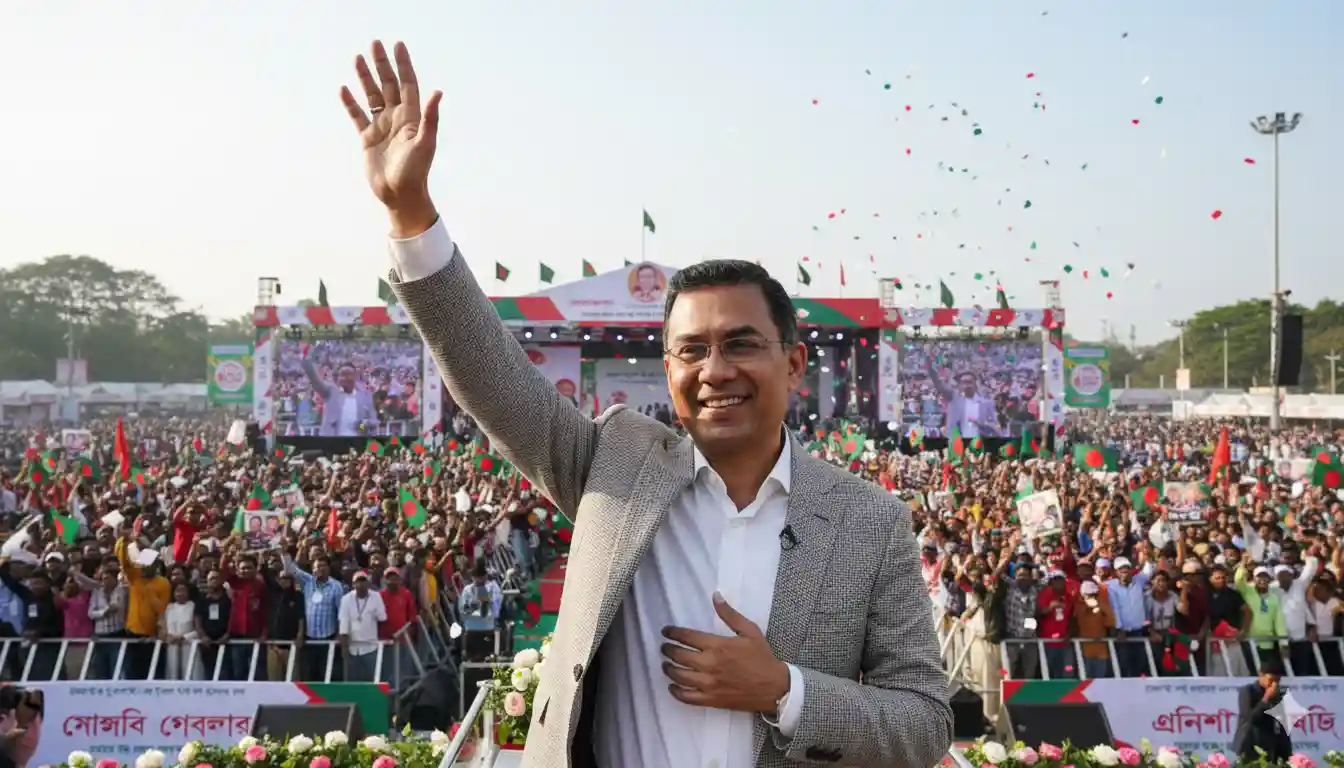

The question of why BNP won the 13th national election deserves deeper reflection. After all, there was widespread hype across every corner of society that Jamaat-e-Islami might finally come to power this time. It is clear that Jamaat had a golden opportunity—one that it ultimately failed to convert into electoral victory.
Once the results were announced, it became evident that Bangladesh Jamaat-e-Islami had secured 68 seats, while the Jamaat-led alliance won a total of 77. Considering that their highest-ever achievement was a mere 18 seats back in 1991, this outcome was by no means insignificant. Indeed, many political analysts had predicted before the election that Jamaat’s public support had grown, and the results largely validated that claim. However, in the existing electoral system, an increase in vote share alone does not guarantee winning 151 out of 300 seats.
No Revolution, No Wave—Just an Election
This election was not the product of any epoch-making revolution, even though it was held in the immediate aftermath of the mass uprising that toppled Hasina’s authoritarian regime in August 2024. Yet, no deep ideological rupture occurred. There was no permanent or radical shift in voter loyalty—at least not to a degree that could fundamentally alter the country’s electoral psyche.
Moreover, this was certainly not a “national wave election”—the kind where people across class, religion, ethnicity, and region all gravitate toward a single party. What actually unfolded was a composite picture: essentially a normal election with some notable deviations, but with results that were, for the most part, predictable.
The Swing Voters and the Anger Factor
Staunch party loyalists mostly stayed home. Instead, it was the swing voters—the undecided and the fence-sitters—who proved decisive. Meanwhile, in various parts of the country, frustration with BNP’s local leadership led to temporary defections, many of which ended up in the laps of Jamaat or the NCP.
The public anger was entirely real. Following the events of August 5, BNP’s grassroots organization had failed miserably. Across districts, petty leaders faced allegations of corruption and extortion. In rural marketplaces and urban fringes, resentment was simmering quietly.
Voters were not merely disappointed; to borrow the language heard at tea stalls and union council courtyards, they were “furious.” It was precisely this fury that fueled Jamaat’s rise. A segment of BNP’s loyal workers, along with a significant number of swing voters, gravitated toward the promise of an “honest alternative.” But inclination is not destiny.
BNP’s Shrewd Nominations and Rural Realities
BNP’s base—historically broader and organizationally deeper than Jamaat’s—did not collapse. Even after the defections, it remained numerically larger. Furthermore, BNP’s nomination strategy proved unexpectedly astute.
Where Jamaat fielded relatively unknown but ideologically committed candidates, BNP placed its trust in the “old guard”—candidates whose names people recognized and whose informal networks ran deep into the social fabric.
In rural Bangladesh, this was especially critical. Urban, educated voters may be stirred by speeches about ethical governance. For them, the idea of a corruption-free, ideologically disciplined candidate serves as a kind of moral awakening.
Rural voters, however, are fundamentally pragmatic. They live within a complex web of patronage. For them, a member of parliament is not an abstract concept; he (and it is usually a he) is a broker of social security, jobs, stability, and dispute resolution. Honesty alone does not guarantee these benefits—but familiarity does.
And therein lay the central dilemma for voters. Many had considered switching sides out of frustration with BNP’s excesses. In constituencies where Jamaat fielded a well-known leader, some did indeed cross over. But elsewhere, voters found themselves facing candidates they did not recognize, whose “honesty” they could not verify, and whose party offered little beyond moral rhetoric. Confronted with uncertainty, they chose the devil they knew.
Jamaat’s Strategic Blunders and the Women’s Vote
Jamaat compounded its structural limitations through strategic missteps. Most notably, its position on women’s issues—oscillating between reassurance and veiled threats—failed to win over a vast segment of female voters. And yet, women now play a critical role in Bangladesh’s public sphere, labor market, and education. A party that cannot present a credible vision of gender equality simply cannot generate a national wave.
Beyond that, many believe that Jamaat’s attempts to soften or reinterpret its historical role during the 1971 Liberation War alienated not only the secular-liberal segment of society but also a vast number of voters beyond that circle.
Even conservative households have drawn a red line when it comes to 1971. The prevailing public sentiment can perhaps be summed up as: “Forgive, maybe. Forget, never.”
A Historic Performance—But Not Enough
Nevertheless, Jamaat’s performance was historic. The party and its allied front secured 77 seats—a testament not only to its disciplined cadre but also, ironically, to BNP’s own misdeeds. Extortion and the arrogance of local BNP leaders had pushed voters into Jamaat’s arms.
In a first-past-the-post (FPTP) system, a swing of just a few percentage points can flip the outcomes of numerous seats. Jamaat exploited the anti-BNP resentment with precision in Rajshahi, Khulna, and Rangpur divisions—regions where its organizational presence is strongest.
But precision and breadth are not the same thing. Jamaat’s rise was regionally concentrated. Its support fluctuated across class, gender, education, and age. These are not the hallmarks of a wave election. Without uniform momentum across the country, winning under FPTP is exceedingly difficult.
The Awami League Factor and Voter Psychology
Then there was the ghost in the machine: the Awami League. Many analysts underestimated its residual vote bank. Surveys suggested that 5 to 7 percent of hardcore supporters would never abandon the party. But beyond them lay a larger segment—perhaps 20 to 25 percent—who were either undecided or unwilling to reveal their preferences. In this election, that segment proved critically important.
Pre-election field research and surveys indicated that many ordinary Awami League voters (the non-hardliners) were leaning toward BNP—not out of ideological affinity, but out of sheer pragmatism. They believed BNP would form the government, and therefore, they tilted in that direction to secure access to benefits through a winning MP.
In areas where BNP’s old-guard leaders had harassed Awami League supporters, some abstained from voting or leaned toward Jamaat. But nationally, the gravitational pull was toward BNP. Voters wanted to be on the winning side. This perception, in the end, became a self-fulfilling prophecy.
Before election day, four possible scenarios had made the stakes abundantly clear. Without significant Awami League voter turnout, BNP would likely win a narrow, hard-fought contest. With moderate Awami League support, they would secure a comfortable majority. And if the Awami League threw its weight behind BNP en masse, even a two-thirds majority was not out of the question. Only a full-blown Jamaat wave—a national awakening transcending class and gender—could have overturned this equation. That wave never came.
Conclusion: The Rise of a New Force
In sum, BNP’s victory was the product of structural advantages, strategic candidate selection, and the pragmatic calculations of the country’s traditional voter base. Jamaat’s self-inflicted wounds on women’s rights and Liberation War history only reinforced this outcome. And paradoxically, while BNP’s local-level misconduct boosted Jamaat’s vote share, it was never enough to defeat the mathematics of the FPTP system.
One notable footnote of this election is the emergence of the National Citizens Party (NCP), which won five seats. In the intensely polarized politics of South Asia, this is no small achievement for a party born out of an uprising.
It signals, however faintly, a public hunger for alternatives beyond the new bipolar politics of BNP and Jamaat. Under a proportional representation (PR) system, such a party might have flourished further. But under FPTP, five seats represent both a remarkable success and a hard ceiling.
Ultimately, Bangladesh’s 13th national election was a story of limits: the limits of anger, the limits of moral branding, the limits of rewriting history, and the enduring power of organizational strength in a winner-take-all system. BNP won not because it inspired the nation—but because it understood the nation.
Source : BBC