

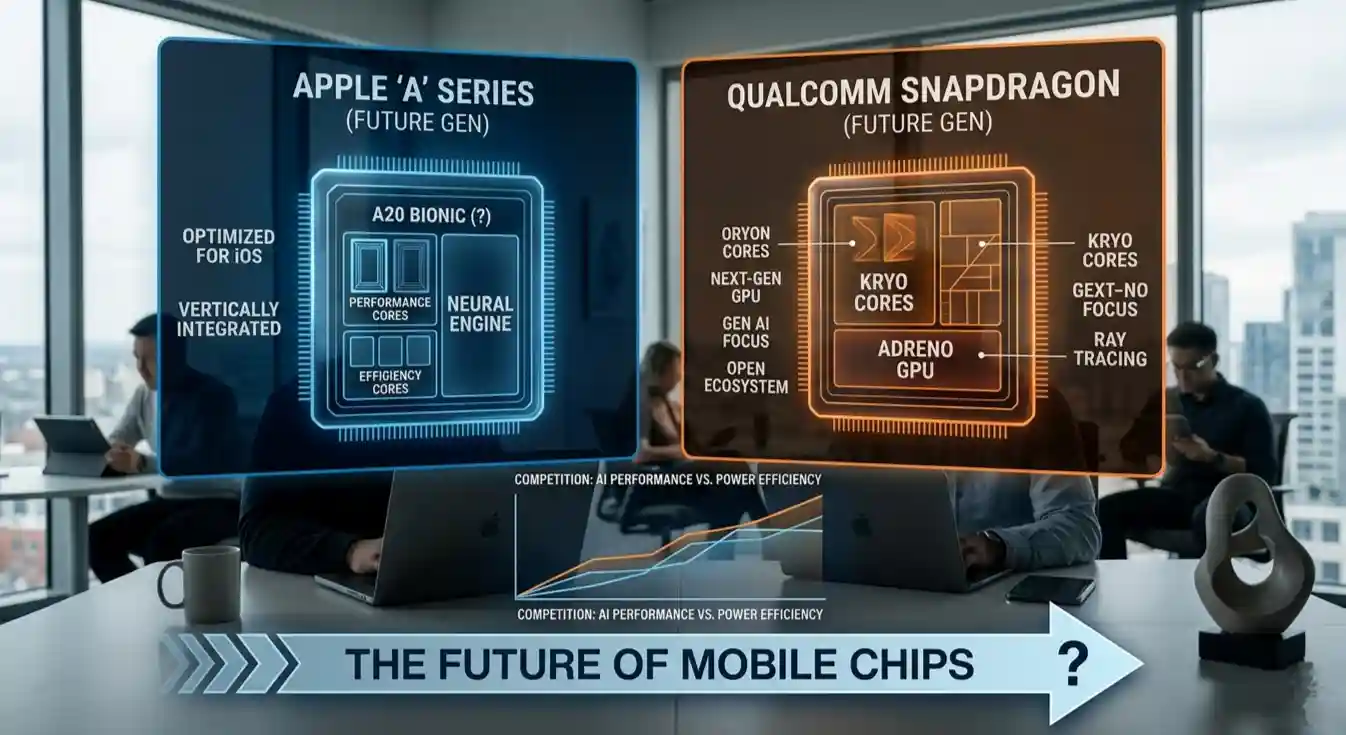
 and Qualcomm’s Snapdragon 8 Gen 5,)
There is no shortage of smartphones in today’s market, and alongside the rapid evolution of devices, smartphone chipsets are also advancing at an incredible pace.
For more than a decade, one question has continued to dominate the tech world: who will ultimately win the battle of smartphone processors? On one side, there is Apple’s custom “A” series silicon, known for its exceptional optimization and premium performance. On the other side, Qualcomm’s Snapdragon processors power most flagship Android smartphones and continue to push the boundaries of mobile computing.
Standing in 2026, as we discuss next-generation chipsets like Apple’s possible A20 Bionic (or its successor) and Qualcomm’s Snapdragon 8 Gen 5, the competition is no longer limited to gigahertz speeds or nanometer technology. Today’s battle revolves around artificial intelligence (AI), generative tasks, and maintaining the perfect balance between performance and battery life.
Advanced Manufacturing Technology
The core strength of any processor lies in its manufacturing process. Both Apple and Qualcomm now rely heavily on advanced fabrication technologies from TSMC.
Apple is expected to use 2nm or highly refined 3nm process nodes in its next-generation “A” series chips. Meanwhile, Qualcomm is attempting to elevate Snapdragon performance through its custom Oryon cores.
Apple’s greatest advantage is vertical integration. The company designs both its hardware and software ecosystem, meaning it knows exactly how its chips will interact with iOS. As a result, Apple can deliver remarkable performance using fewer transistors and less power.
Qualcomm, however, is now challenging Apple’s dominance with its custom-core architecture, significantly narrowing the performance gap.
Performance: Apple Still Leads in Single-Core Power
Historically, Apple has remained nearly unbeatable in single-core performance. If you frequently perform tasks such as video editing or high-resolution rendering, Apple’s chips still maintain a slight advantage.
Particularly in terms of latency and app responsiveness, Apple’s “A” series delivers an extremely smooth and refined experience.
Qualcomm’s GPU Power and Gaming Advantage
In the GPU department, Qualcomm has made extraordinary progress over the last few years. Snapdragon processors are now giving Apple serious competition in gaming performance and ray tracing technology.
If you are a hardcore mobile gamer, Qualcomm’s latest Snapdragon chips can deliver stunning graphics rendering and smoother gameplay experiences.
AI and NPU: The New Battlefield
Since 2024–2025, the center of smartphone chip discussions has shifted toward NPUs (Neural Processing Units). Smartphones are no longer used only for calls or photography—they now generate text, edit images, and provide real-time translation using generative AI.
Apple Intelligence
Apple is prioritizing on-device AI processing in its next-generation chips. The company’s goal is to perform advanced AI calculations directly on the device while maintaining maximum user privacy.
Qualcomm’s AI Engine
Qualcomm’s biggest advantage is its open ecosystem. The company collaborates with third-party developers to optimize Android devices for faster AI performance.
Snapdragon processors are currently extremely competitive when it comes to running Large Language Models (LLMs) and advanced AI workloads.
Heat Management and Battery Efficiency
Powerful chips naturally produce more heat. In this area, Apple remains ahead due to its impressive energy efficiency.
Even though iPhones often include smaller batteries compared to Android flagships, they still provide excellent battery backup thanks to the efficiency of Apple’s “A” series chips.
Qualcomm has significantly reduced heating issues in recent generations, but during long gaming sessions or high-performance tasks, Snapdragon-powered devices may still become warmer than iPhones.
However, Qualcomm remains far ahead in fast charging technology.
Real-World Experience Matters More Than Benchmarks
Benchmark scores do not always represent real-world performance. On paper, Apple may achieve higher scores, but average users may not notice a major difference between Apple and Snapdragon devices in daily use.
Apple offers unmatched stability, while Qualcomm provides versatility and customization.
Which One Is Better for You?
If your priorities include:
- software and hardware optimization,
- long-term updates,
- professional video production,
- and stable performance,
then Apple’s next-generation “A” series chipset will likely be the better long-term investment.
On the other hand, if you prefer:
- mobile gaming,
- advanced connectivity,
- fast charging,
- and flexible AI-powered features,
then Qualcomm’s Snapdragon processors may satisfy you more.
Final Verdict
The competition is no longer simply about “which chipset is better.” Instead, it is about which company understands your needs more effectively.
Current trends suggest that Qualcomm is rapidly closing the gap with Apple. If this momentum continues, maintaining its throne may become a serious challenge for Apple in the coming years.
Our Opinion
The biggest winners in this battle between two smartphone giants are ordinary users like us. Because of this intense competition, we continue to receive more powerful, efficient, and intelligent smartphones every year.
There is little doubt that the next generation of mobile chipsets will completely transform the smartphone experience in the near future.