

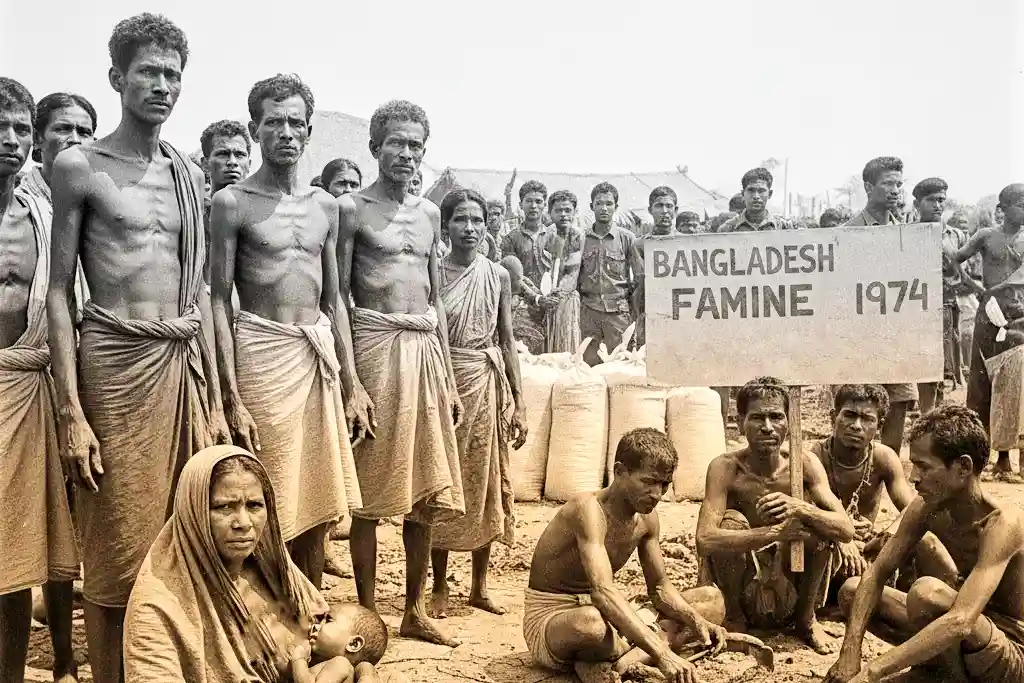

Turning the pages of history, it is seen that the year 1974 came as an extreme curse to the war-torn newly independent Bangladesh. Before overcoming the devastation of the Pakistani occupation forces, Bangladesh was hit by a great disaster due to the blows of nature and international politics, which is known in history as the ’74 famine’.
There was no single reason behind the famine of 1974, but rather an unfortunate combination of several circumstances. The Brahmaputra River overflowed its banks, greatly disrupting crop production that year. Food shortages became apparent as paddy fields were submerged in the northern districts. At that time, a major reason behind the price of rice going beyond the purchasing power of the common people was the syndicate of a group of unscrupulous businessmen. At that time, the United States stopped food aid to Bangladesh under the PL-480 project, which further accelerated the crisis.
The images that appeared on the pages of newspapers at that time were heartbreaking. Be it the picture of the famous Chilmari in Kurigram’s ‘Basanti’ or the wailing of thousands of people in the langarkhana for a handful of rice – all were extreme signs of humanitarian disaster. At that time, although the official death toll was said to be around 27,000, many private statistics put the number in the hundreds of thousands. At that time, many people sold their small children in their arms just for a handful of rice. Many wives or young girls ran away with the hands of strangers for a handful of rice. At that time, they were not so afraid of these things, when you have no rice in your stomach and no one to feed you, who can really think about these things. Most people at that time lived in pain with a half-empty stomach.
Mothers had no breast milk. Their bodies were just bones without meat. Many children died at birth, and their mothers also died. Even those who were born healthy died of hunger as they grew up. Many women committed suicide at that time, unable to bear the pain of hunger.
The experience of that famine has taught Bangladesh an important lesson: food security and self-sufficiency. Bangladesh has made incredible progress in agriculture in the last few decades. As a result of the development of high-yielding varieties and the modernization of the irrigation system, the country is now largely self-sufficient in food.
That famine of 1974 has taught us how important it is for a state to ensure not only independence, but also the right to rice.
As today’s modern Bangladesh walks the path of becoming digital and smart, it is important to remember those days of the past. Although the famine has now become a part of history, market control and food supply at a fair price were not ensured. The causes of the famine were many and complex, and they are still debated. However, there is no monument, no museum, and not even a plaque has been erected anywhere in the world to commemorate these dead people.