


Hinduism is one of the world’s oldest living faiths. Its evolution spans thousands of years. Although cows are now regarded as extremely sacred and objects of worship in Hinduism, historical records reveal various opinions about whether they were edible or not. In particular, from the Rigvedic era through the Manusmriti and the modern Puranic age, the status of cows has changed repeatedly.
Many claim that in the Vedic era, sages and gods ate cattle. This claim is rooted in the interpretation of certain sukta in the Rig Veda and Atharva Veda.
Some verses in the Rig Veda (e.g., 10.86.14) mention that bulls were often sacrificed for the god Indra. Similarly, Agni is referred to as ‘Ukshanna’ (one whose food is a bull) or ‘Vashanna’ (one whose food is a barren cow).
Hospitality (Gaghn): In ancient India, a guest was called a ‘gaghn.’ Its literal meaning is ‘for whom a cow is killed.’ Panini’s grammar and the Grihya Sutras also mention the use of meat as Madhuparka (a special meal to welcome a guest).
However, there is a significant theoretical difference here. According to many scholars, the meanings of ancient Sanskrit words have changed over time. The word ‘aghnya’ (which cannot be killed) is used for cows at least 16 times in the Rig Veda. This means that in the Vedic era, not only was the cow edible, but there were also strict instructions to protect it.
The directive to protect the cow in Hindu scriptures is primarily based on its utility. In an agrarian society, oxen were essential for plowing, and cows for milk. The Atharva Veda describes the cow as the ‘Mother of the Earth.’
According to scripture, 33 crore (or, according to some, 33 types) of deities reside in the body of a cow. At the heart of this belief is the cow’s panchagavya (milk, curd, ghee, cow dung, and cow urine), which is not only nutritious but is also used for purification in various religious ceremonies.
To understand the evolution of dietary practices in Hinduism, one must observe several stages:
Period perspective: main reference – Vedic era: sacrificial offerings and consumption in special cases. Rig Veda, Satapatha Brahmana. Dharma Sūtras and Manusmriti: although meat eating is permitted, strict prohibitions on beef begin (Manusmriti 5.27–44). Puranic era: the cow is fully established as a deity and mother. Mahabharata, Bhagavata Purana.
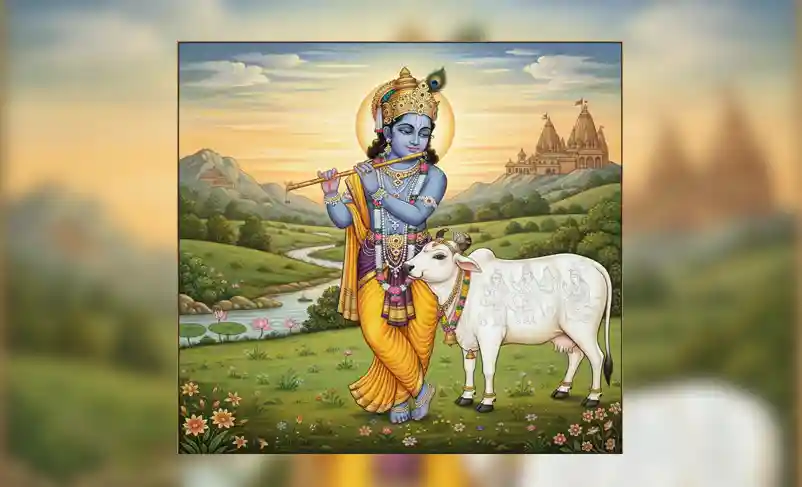
In the Shanti Parva of the Mahabharata, it is clearly stated, “Gorakshya is the supreme dharma.” It says that a person who kills a cow falls into a terrible hell. In the Shrimad Bhagavad Gita, Shri Krishna himself has emphasized cow service and cow protection, and he became known as ‘Gopal’.
Yagna is at the heart of this debate. In ancient times, animal sacrifice was a part of Yagna. However, thinkers like Swami Vivekananda have noted that although beef consumption was once common, it was later prohibited because society came to understand that a living cow is more beneficial to society than a dead one.
According to most scholars, where the Vedas speak of eating meat, in most cases ‘bull’ was meant, and it was only for special sacrificial ceremonies. For the common people, eating beef was never a common dietary practice.
When Buddhism and Jainism arose, the principle of “ahimsa” (non-violence) gained prominence. Hinduism also embraced this great principle and reduced animal sacrifices.
India is an agrarian country. Cows were the backbone of the economy. Therefore, protecting cows became a religious imperative.
Just as a cow selflessly gives milk, she has been elevated to the status of a mother. Just as eating one’s own mother is unthinkable, so too is eating beef considered a sin by Hindus.
In short, although some parts of Vedic literature mention animals in the context of yajña (sacrificial rites), all subsequent scriptures (Puranas, Smritis, Upanishads) have declared the cow sacred and non-kidable. For a follower of Hinduism today, eating beef is not scripturally sanctioned. It is not merely a religious belief, but a cultural and emotional identity.