

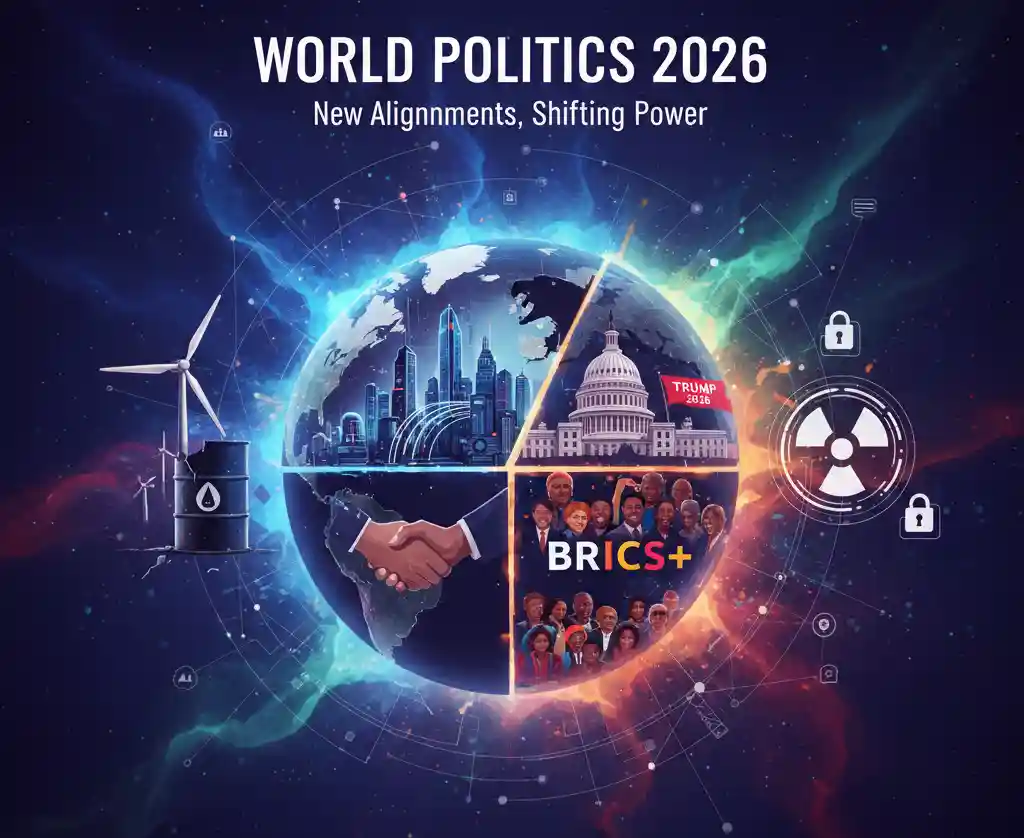

The year 2026 is not just another ordinary year in the history of world politics; rather, it is being marked as a ‘year of transformation’. The long-term impact of the Ukraine-Russia war, instability in the Middle East, and especially the radical shift in U.S. domestic politics are collectively giving rise to a new world order. A world that was once unipolar has now clearly become multipolar.
In 2026, the United States remains the central hub of global politics. Donald Trump’s re-election and his ‘America First’ policy have reshaped the dynamics of international relations. Executive orders and tariff policies under Trump have widened the commercial distance between the U.S. and its allies in Europe and Asia. Particularly with NATO, The announcement to reduce dependence on the US is forcing European countries to strengthen their own defense systems.
In 2026, tensions in the Asia-Pacific region have reached a peak. China is now not just an economic power, but has emerged as an ‘Electrostate’. Semiconductor technology, artificial intelligence (AI) and its monopolistic dominance in the renewable energy market have challenged the United States.
The cold war between Beijing and Washington over the Taiwan issue has now escalated into cyber warfare and economic sanctions. With increased military exercises in the South China Sea, the region is at risk of a major conflict at any time.
The conflict between Iran and Israel has taken on a new dimension in Middle Eastern politics in 2026. Iran’s nuclear