

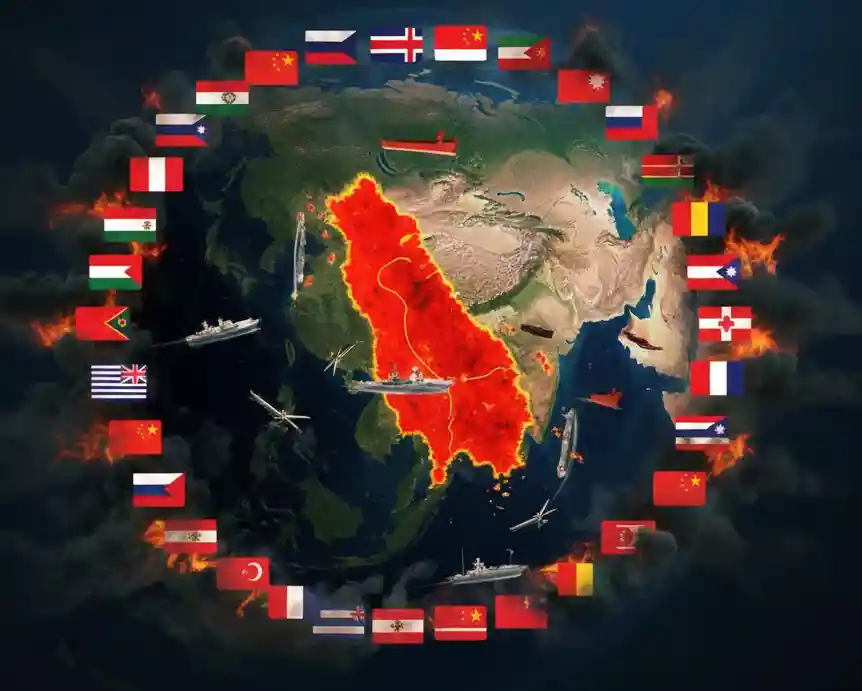

The Taiwan Strait has been identified as the most dangerous and sensitive spot in the current global geopolitical context. The decades-long China-Taiwan conflict is no longer just an internal war; it has become a major challenge to the security and economy of the Asia-Pacific region and the entire world. Recently, military exercises and diplomatic sparring in the South China Sea have taken this tension to a new high.
China considers Taiwan an inalienable part of its territory and has pledged to reunify the island with the mainland, even by force if necessary. On the other hand, Taiwan has been claiming itself as an independent and sovereign nation. The division dates back to the 1949 civil war. However, the current tensions are driven by the current Taiwanese leadership’s attempt to maintain the ‘status quo’ and their growing military and strategic ties with the United States.
According to Beijing, providing military assistance to Taiwan, which goes against the U.S. ‘One China Policy,’ is a direct interference in China’s internal affairs. On the other hand, Taipei believes that ensuring its independence and security is essential for preserving the global democratic order after the war in Ukraine.
In recent months, China’s ‘ The People’s Liberation Army (PLA) has conducted unprecedented military activities. Chinese warplanes are violating Taiwan’s Air Defense Identification Zone (ADIZ) almost daily. Experts believe this is not just a show of force, but a prelude to a long-term blockade or a potential invasion.
In response, Taiwan has also increased its defense budget and is trying to secure itself with US-made Harpoon missile systems and advanced F-16 fighter jets. The US Navy’s regular presence in the Asia-Pacific region and joint exercises with Japan and the Philippines have become a major cause for concern for China.
New military and economic alliances are emerging in the Asia-Pacific region centered on the Taiwan issue.
This alliance of the United States, Japan, Australia, and India is working to counter Chinese influence.
This security pact between Australia, the United Kingdom, and the United States has paved the way for the deployment of nuclear submarines in the Pacific region.
Although historically following a pacifist policy, Japan has recently begun to increase its military capabilities and take a more direct stance on the Taiwan issue. According to Japan, “A crisis in Taiwan is a crisis for Japan.”
Economic Influence and Semiconductor Politics
China-Taiwan tensions are not limited to fears of war; the fate of the global economy is also at stake. Taiwan is the world’s largest producer of advanced semiconductors, or chips. The Taiwan Semiconductor Manufacturing Company (TSMC) supplies more than 90 percent of the world’s advanced chips.
If a military conflict were to break out in the region, the supply chains for the global smartphone, automotive, and defense industries would be completely disrupted. This could push the global economy into a deep recession. China is also aware of the risk of this economic damage, as its own tech industry is also heavily dependent on these chips.
The United States’ Strategic Ambiguity and Current Position
For a long time, the United States has maintained ‘strategic ambiguity’ on the Taiwan issue or a policy of strategic ambiguity. That is, it was unclear whether the United States would directly engage in a war if Taiwan were attacked. But the current Biden administration has repeatedly indicated that Washington will not stand idly by if Beijing launches any aggression. This shift in position has further angered Beijing.
According to analysts, this crisis could reach its peak between 2026 and 2030. However, a full-scale war would be catastrophic not only for Asia but for humanity as a whole. What is needed at this moment is high-level diplomatic talks.
The countries of the Asia-Pacific, especially ASEAN (ASEAN) member states do not want the region to become a battleground for great powers. They are emphasizing peace and stability. The competition between China’s ‘Belt and Road Initiative’ (BRI) and the United States’ ‘Indo-Pacific Strategy’ is now revolving around Taiwan.
Peace in the Taiwan Strait is not just a matter of territorial integrity; it is a symbol of the balance of the global order. If China-Taiwan tensions are not de-escalated, the Asia-Pacific region will be plunged into a prolonged period of instability. Only the wisdom and diplomatic foresight of world leaders can save the planet from a potential third world war.
The Taiwan Strait has been identified as the most dangerous and sensitive spot in the current global geopolitical context. Rather, it has become a major challenge to the security and economy of the Asia-Pacific region and the entire world. Recently, military exercises and diplomatic disputes in the South China Sea have taken this tension to a new level.