

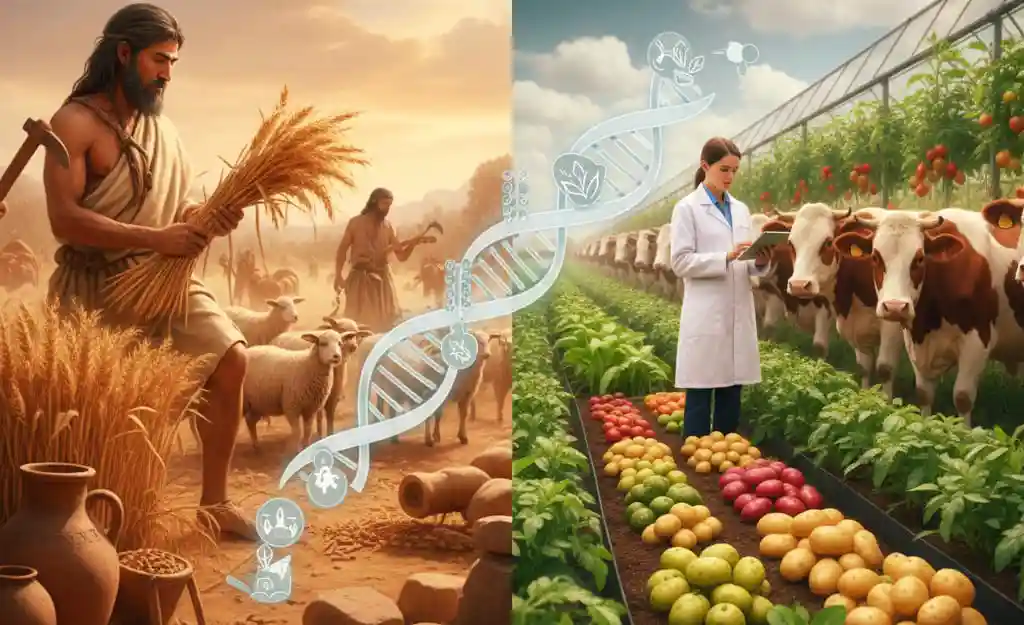

For millennia, humans have lived in a quiet but profound struggle to master the natural world. This journey began the moment our ancestors abandoned their nomadic lifestyle to build permanent settlements. While we often think of technology as a modern invention, the most powerful tool in human history is nearly 10,000 years old: Selective Breeding. Since the end of the last Ice Age, this practice has served as the backbone of global food security and the very blueprint of the biodiversity we see today.
The Dawn of a Biological Revolution
The story of human-driven evolution finds its roots in the Fertile Crescent, the historic region nestled between the Tigris and Euphrates rivers. As the climate shifted after the Ice Age, hunter-gatherer groups in the Levantine corridor began a daring experiment. They started cultivating wild wheat and barley, marking the birth of organized agriculture.
Roughly 1,000 years later, a similar revolution occurred in the Zagros Mountains, where humans began domesticating goats. This was not an isolated event. Across the globe—from the highlands of Mexico and the river valleys of China to the plains of North America—civilizations independently discovered that they could steer the course of nature to meet their needs.
Darwin’s Insight: Methodical vs. Unconscious Selection
Charles Darwin, the father of evolutionary biology, recognized that humans do not just observe nature; we actively edit it. He categorized selective breeding into two distinct paths. First, he identified Methodical Selection. In this approach, humans work with a specific goal in mind, such as increasing milk production in cattle or creating a particular shade of silk.
The second path is Unconscious Selection. This occurred when ancient farmers naturally saved the best seeds from their harvest or kept the calmest animals for breeding without a formal scientific plan. The high-yield wheat we eat today and the loyal hunting dogs of antiquity are the legacy of this subtle, unintentional guidance.
Survival of the Fittest vs. Survival of the Useful
There is a fundamental tension between natural selection and selective breeding. Natural selection favors traits that enhance an organism’s “fitness” or its ability to survive and reproduce in the wild. In contrast, selective breeding emphasizes alleles that benefit human beings.
Ironically, these human-favored traits often make an animal or plant less fit for the wild. For example, many domesticated animals have smaller body sizes, and certain crops have lost their “seed dormancy,” meaning they cannot survive a harsh winter without human intervention. Over time, these species have become entirely dependent on us for their survival. We didn’t just change them; we became their guardians.
| Era | Region | Achievement |
| 10,000 BCE | Fertile Crescent | First cultivation of wild wheat and barley |
| 9,000 BCE | Zagros Mountains | Domestication of goats for meat and milk |
| Ancient Era | India/Macedonia | Alexander the Great selects elite Indian cattle |
| Pre-Columbian | Peru | Incan selection of high-altitude pack animals |
Why Certain Species Changed the World
Not every creature was a candidate for this biological partnership. Anthropologists point out that the most successful domesticated animals shared specific traits: they were social and possessed a naturally docile temperament. Cows, sheep, and dogs were the primary targets because they could live in groups and accept human leadership.
On the other hand, aggressive or highly territorial animals, such as large carnivores or solitary cats, proved much harder to control. Furthermore, humans prioritized species that could reproduce quickly. The faster a plant or animal produced offspring, the sooner the breeder could see and select the desired traits.
From Ancient Scriptures to Modern Science
The history of selective breeding is woven into our oldest stories. The Book of Genesis in the Bible mentions techniques used to change the coat colors of sheep. Centuries later, historical records show that Alexander the Great was so impressed by Indian cattle that he sent thousands back to Macedonia to improve local breeds. In South America, the Incas mastered the art of separating the strongest llamas to ensure their empire had the best transport animals.
Today, when we look at a supermarket shelf filled with diverse potato varieties or enjoy the sweetness of a hybrid fruit, we are seeing the results of thousands of years of labor. Our faithful pets are not just companions; they are living testaments to human intelligence merging with environmental necessity.
The Challenges of the Future
While selective breeding has fed billions, it comes with a cost. Modern scientists are increasingly worried about the loss of “wild genomes.” As we focus on a few high-performing varieties, we risk losing the natural genetic diversity that helps species resist new diseases or adapt to a changing climate.
Current research focuses on preserving wild ancestors of our food crops. By maintaining this genetic library, we ensure that future generations have the tools to tackle food crises. We are no longer just breeders; we must become the conservators of the very diversity we once sought to control.
“Selective breeding is the bridge between the wild world we found and the civilized world we built. It represents the ultimate collaboration between human ambition and biological potential.”
Summary of Differences
- Natural Selection: Driven by environmental pressure; results in wild survival.
- Selective Breeding: Driven by human choice; results in domestic utility.
- Result: Domesticated species often lose their ability to survive without human help.
Selective breeding remains an ongoing masterpiece. From the first grain of wheat in the Fertile Crescent to the advanced genomic editing of today, we continue to shape the world around us. As we look toward the future, the challenge lies in balancing our need for productivity with the necessity of preserving the earth’s original, wild biological heritage.