

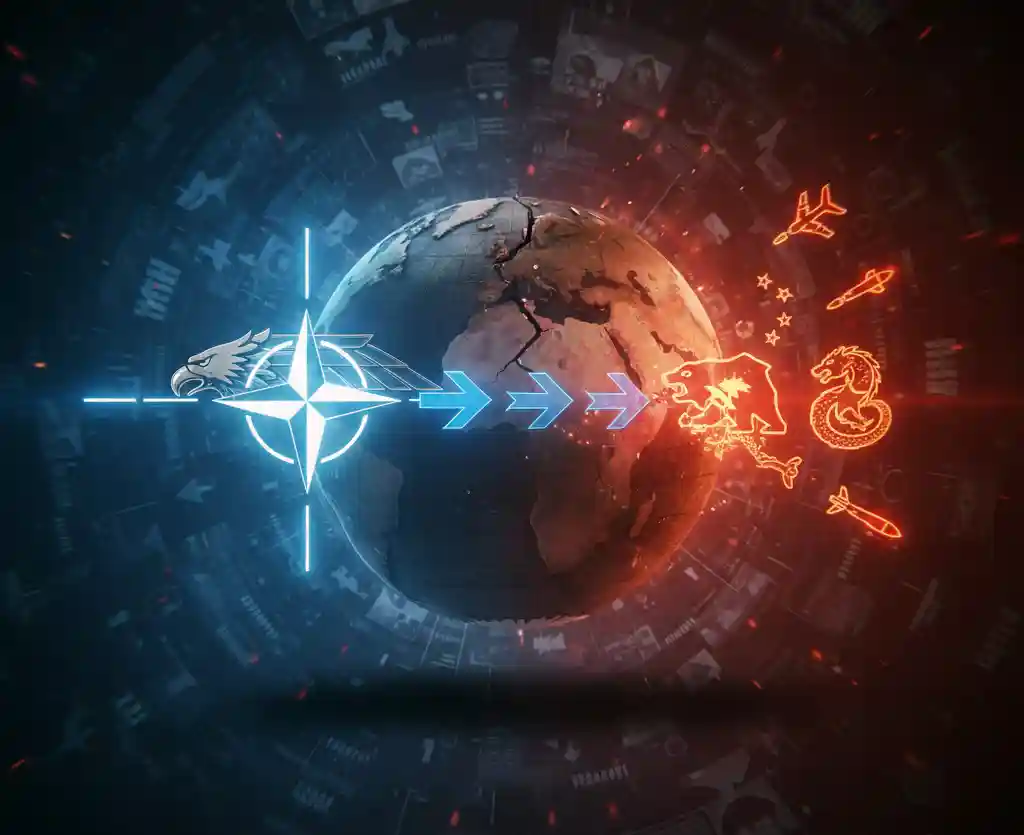

In the post-Cold War era, no name in global politics is as debated or consequential as NATO (North Atlantic Treaty Organization). Standing here in 2026, the alliance’s northward and eastward expansion has pushed global security into a period of profound crisis. Following the induction of Finland and Sweden, NATO’s persistent interest in Ukraine and Georgia has spiked the risk of a direct military confrontation with Moscow. Analysts argue that this territorial growth is no longer just a defense strategy—it is a disruption of the global balance of power.
Eastern Europe remains the eye of the storm. Early in 2026, high-level NATO meetings revisited the roadmap for Ukraine’s membership. The Kremlin has issued repeated warnings, stating that NATO’s presence at Russia’s doorstep constitutes an existential threat.
History recalls the 1990s, when NATO reportedly signaled it would not expand “one inch eastward.” Today, with the alliance touching Russian borders, the Putin administration has intensified its military readiness. European skies are now heavy with hypersonic missile tests and large-scale drills, leading security experts to fear that the specter of nuclear conflict is no longer a distant impossibility.
NATO’s reach now extends far beyond the Atlantic. Between 2025 and 2026, strategic partnerships with Japan, South Korea, and Australia have solidified. Beijing has condemned this “Asian version of NATO,” claiming it undermines regional stability.
This pivot to counter China’s military rise has turned the South China Sea into a powder keg. With the U.S. and its NATO allies on one side, and the China-Russia-North Korea axis on the other, the world is shifting toward a volatile triple-polarity.
NATO members have now pledged to spend between 2.5% and 3% of their GDP on defense. In 2026, European military budgets have shattered 50-year records:
- Germany and France: Have increased defense spending by nearly 15%.
- Poland and the Baltic States: Are pouring billions into NATO military infrastructure.
However, this obsession with weaponry comes at a human cost. As billions flow into the military-industrial complex, vital sectors like education, healthcare, and climate action are being sidelined. With citizens grappling with inflation and energy shortages, the “arms race” is fueling domestic social unrest.
With the New START nuclear arms treaty effectively lapsing in February 2026, the world has entered an era of unregulated competition. As NATO expands, the space for diplomacy shrinks.
Renowned strategist Dr. Richard Haass notes: “The irony of NATO expansion is that it was meant to provide security, yet it has bred profound insecurity. No one is coming to the table; everyone is speaking the language of force.”
2026 marks a historical crossroads. If NATO’s expansion continues unchecked and the Russia-China alliance hardens in response, the drums of a “Third World War” may soon become deafening.
The global community argues that instead of mere expansion, NATO must work toward a long-term security framework that includes Russia. Otherwise, this display of military might could lead to an irreparable humanitarian catastrophe. While NATO is currently at its strongest in history, the world is at its most fragile. If expansion becomes the catalyst for war, one must ask: Who is this “protection” really for? History proves that military power alone cannot sustain peace; it requires the wisdom of restraint.