

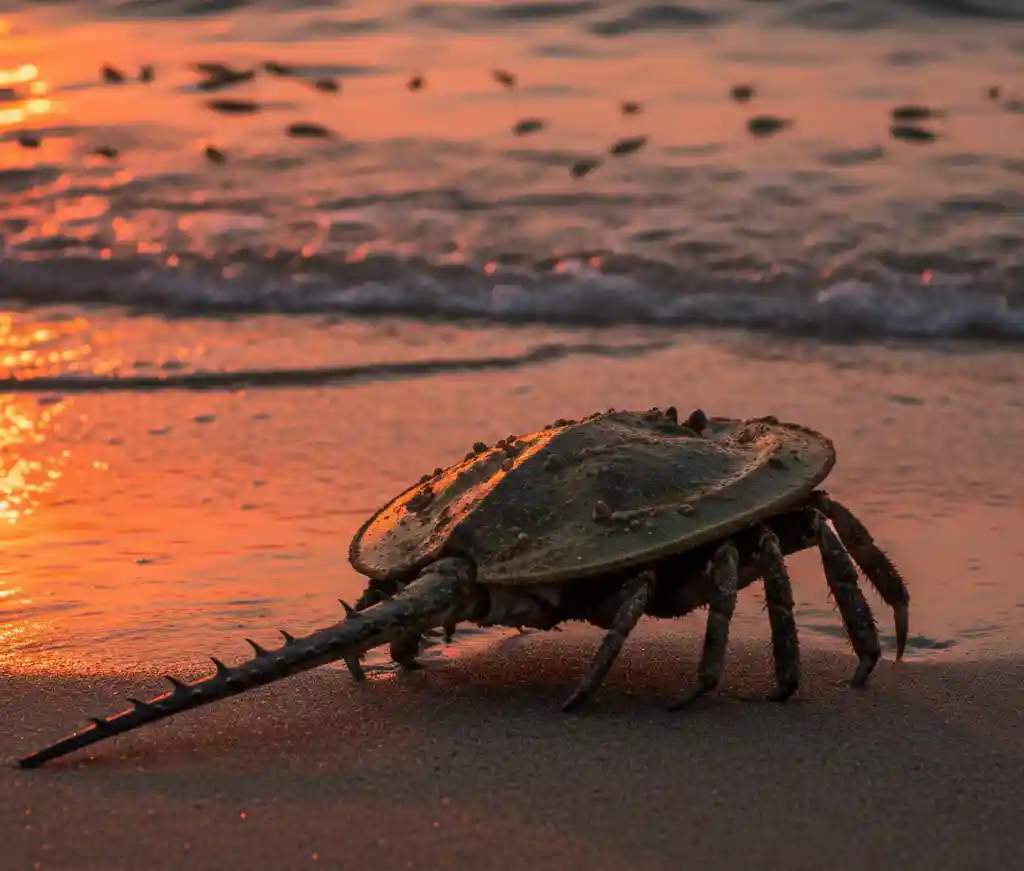

A Living Fossil Among Us
Imagine a creature that has survived five mass extinctions, outlived the dinosaurs, and remained virtually unchanged for over 440 million years. This is the horseshoe crab (Limulus polyphemus), an ancient arthropod that crawls onto the sandy beaches of the Mid-Atlantic every spring. While they might look like something out of a prehistoric film, these “living fossils” are actually more closely related to spiders and scorpions than to true crabs. Today, their story is one of survival, medical miracles, and a desperate struggle against human encroachment.
The Grand Spectacle of Delaware Bay
Every year during the full and new moons of May and June, Delaware Bay becomes the stage for one of nature’s greatest shows. Thousands of horseshoe crabs emerge from the Atlantic depths to spawn. The females, often carrying a smaller male on their backs, dig into the sand to deposit clusters of tiny green eggs. This event is not just a reproductive ritual; it is a lifeline for the entire ecosystem.
A Migration at Risk
The American red knot, a small shorebird, depends entirely on this spawning event. These birds fly thousands of miles from the southern tip of South America to the Arctic. Delaware Bay is their most critical pit stop. They arrive exhausted and hungry, needing the protein-rich horseshoe crab eggs to fuel the rest of their journey. However, as crab populations plummeted by nearly 90% between 2002 and 2017, the red knot population followed suit. When we lose the crabs, we lose the birds. It is a domino effect that threatens the biodiversity of our coastlines.
The Miracle of Modern Medicine
While nature lovers admire the crab for its ecological role, the medical world values it for something else: its blue blood. Horseshoe crabs possess a primitive but incredible immune system. Their blood contains a clotting agent called coagulogen. This substance can detect even the smallest trace of bacterial contamination—down to one part per trillion.
In 1956, scientists Frederick Bang and Jack Levin discovered that this blood could create the Limulus Amoebocyte Lysate (LAL) test. Today, the FDA requires the LAL test for every injectable drug, vaccine, and surgical implant. If you have ever received a flu shot or an IV, a horseshoe crab likely ensured it was safe. This “blue gold” is worth tens of thousands of dollars per gallon, making the crab a cornerstone of a multi-billion dollar industry.
Bait, Blood, and Buildings
Despite their importance, humans are the greatest threat to horseshoe crabs. For decades, the commercial fishing industry used them as cheap bait for eel and whelk. Although regulations have improved, bycatch in fishing nets remains a significant issue.
Furthermore, the biomedical industry’s “catch and release” practice is more lethal than previously thought. While technicians return the crabs to the ocean after drawing blood, studies show that nearly 30% of these animals die from the stress of the process. Added to this is the relentless development of beachfront properties, which destroys the sandy shores these creatures need to lay their eggs.
A Path Toward Recovery
The news is not all bleak. Recent data suggests that populations in the Mid-Atlantic are beginning to stabilize. Conservationists are working hard to protect spawning beaches and encourage the use of synthetic alternatives to LAL. If we can balance our medical needs with ecological preservation, we can ensure that this ancient guardian continues to patrol our shores for another few million years.