

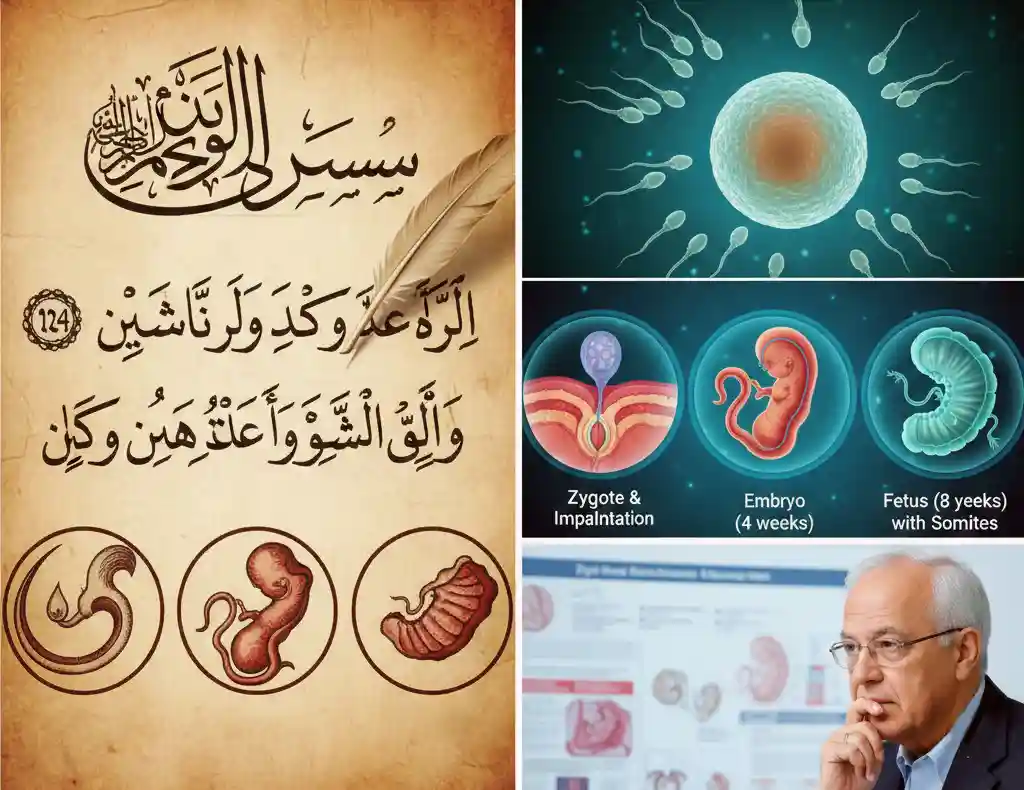

The mystery of human creation has always been at the center of human curiosity. Today, thanks to modern medicine and advanced technology, we can understand the various stages of fetal development in great detail. However, the truly astonishing fact is that the core principles of modern embryology were accurately described in the Holy Quran nearly 1,400 years ago.
Stages of Embryonic Development Described in the Quran
The sequential stages of human creation are described in Surah Al-Mu’minun (Verses 12–14) of the Holy Quran. The passage states:
“And indeed, We created man from an extract of clay. Then We placed him as a drop of fluid (Nutfah) in a safe lodging (the womb). Then We made the drop into an ‘Alaqah’ (a leech-like suspended object), then We made the ‘Alaqah’ into a ‘Mudghah’ (a chewed-like substance), then We made out of that ‘Mudghah’ bones, and We clothed the bones with flesh; then We developed him into another creation.” (Surah Al-Mu’minun: 12-14)
Analysis from the Perspective of Modern Science
Modern embryologists have been amazed by the alignment between these Quranic terms and contemporary scientific findings.
- 1. Nutfah (Sperm/Zygote): Science confirms that out of millions of sperm, only one fertilizes the egg. The Quran refers to this as Nutfatun Amshaj, or a “mingled drop.”
- 2. Alaqah: The Arabic word Alaqah has three meanings: a leech, a suspended thing, and a blood clot. Modern ultrasonography shows that in its early stages, the embryo clings to the uterine wall much like a leech and resembles a clot of blood.
- 3. Mudghah: This translates to “something that has been chewed.” When the embryo reaches this stage, “somites” develop on its back, which look exactly like teeth marks on a piece of chewed meat.
- 4. Formation of Bones and Flesh: It was once believed that bones and muscles formed simultaneously. However, modern embryology has proven that the cartilaginous skeleton forms first, and only afterward do the muscles (flesh) cover them—exactly the sequence described in the Quran.
Perspectives of World-Renowned Scientists
Dr. Keith L. Moore, a professor in the Department of Anatomy at the University of Toronto and a world-renowned embryologist, stated after reviewing these Quranic descriptions:
“It has been a great pleasure for me to help clarify statements in the Quran about human development. It is clear to me that these statements must have come to Muhammad from God, because almost all of this knowledge was not discovered until many centuries later.”
Dr. Moore even incorporated Quranic references into a special edition of his acclaimed textbook, The Developing Human.
Conclusion
The progress of science continues to reveal the unknown, and in doing so, it repeatedly validates the truths found in the Quran. It would have been impossible for any human in the 7th century to provide such an accurate description of embryology. This is not merely a matter of religious faith but a profound subject of reflection for any rational mind.
References:
- Al-Quran (Surah Al-Mu’minun: 12-14, Surah Al-Qiyamah: 37-39).
- The Developing Human – Dr. Keith L. Moore.
- Human Embryology as Described in the Quran and Sunnah – Keith L. Moore and others.