


. Read about the Battle of Hattin, the conquest of Jerusalem, and his legendary chivalry during the Crusades against King Richard.)
In the vast pages of history, there are certain names written in golden letters that transcend the boundaries of time to become immortal. Undoubtedly, Sultan Salahuddin Yusuf Ibn Ayyub (RA) was one such timeless figure. He was not merely a great conqueror; rather, he was the embodiment of justice and humanity. Known as ‘Salahuddin’ in the Muslim world and ‘Saladin’ in the Western world, he restored the lost glory of Muslims by liberating Jerusalem from the hands of the Crusaders. Simultaneously, he laid the foundation of the Ayyubid Sultanate.
Chapter One: Birth and Lineage
Salahuddin was born in the city of Tikrit, Iraq, in 1137 (or according to some accounts, 1138 AD). Notably, he was not Arab by ethnicity, but of Kurdish descent. His father’s name was Najmuddin Ayyub, and his grandfather was Shadi Ibn Marwan. At that time, his father served as the governor of the Tikrit fortress.
The night of Salahuddin’s birth was incredibly dramatic for his family. Due to political circumstances, his father was forced to leave Tikrit with his family that very night. Consequently, the family embarked on a journey toward an uncertain future. Finally, the Turkish ruler of Mosul, Imaduddin Zengi, granted them refuge. Since Salahuddin’s father was a highly skilled administrator, Imaduddin Zengi appointed him as the governor of the city of Baalbek. It was here that Salahuddin spent his childhood days.
Chapter Two: Education and Upbringing
During his boyhood, Salahuddin moved to Damascus. There, he came into the company of the greatest scholars and theologians of the time. From the beginning, he was extremely brilliant and possessed a calm demeanor. He memorized the Holy Quran and acquired deep knowledge in the science of Hadith. Moreover, he possessed immense scholarship in Fiqh (Islamic jurisprudence) and Arab genealogy.
However, he did not limit himself solely to religious education. Simultaneously, he studied mathematics, geometry, and astronomy. Alongside this, he made himself proficient in military training. His uncle, Asaduddin Shirkuh, was one of the finest generals of that era. Fundamentally, it was from his uncle that he mastered the techniques of swordsmanship, spear throwing, and horsemanship. Thus, a wonderful combination of knowledge and power occurred within him.
Beginning of Career and the Egypt Campaign
Salahuddin’s career began in the army of Sultan Nuruddin Zengi, the ruler of Damascus. At that time, the political situation in the Middle East was extremely complex. Egypt was then ruled by the Fatimid Caliphate. However, these Shia rulers were plagued by internal strife. On the other hand, the Crusaders were plotting to capture Egypt.
In this situation, Nuruddin Zengi decided to launch a campaign in Egypt. He sent General Shirkuh with a massive army. Naturally, the young Salahuddin joined this campaign with his uncle. Although he initially did not want to go on this expedition, destiny pulled him along. Upon reaching Egypt, he displayed extraordinary heroism. Finally, expelling the Crusaders, Shirkuh took control of Egypt.
Vizier of Egypt and the Shift of Power
In 1169, his uncle Shirkuh suddenly passed away. Subsequently, the Fatimid Caliph of Egypt, Al-Adid, fell into a crisis regarding the appointment of a new Vizier. Eventually, he chose Salahuddin as the Vizier. The Caliph thought that since Salahuddin was young and inexperienced, he could be kept as a puppet.
But Salahuddin was extremely prudent and foresighted. After taking charge, he quickly consolidated his position. He appointed his own trusted people to every level of the administration. Gradually, he began to curtail Fatimid influence. In 1171, he made a historic decision. He announced the formal dissolution of the Shia Fatimid Caliphate in Egypt. Instead, he included the name of the Sunni Abbasid Caliph of Baghdad in the Friday sermon (Khutbah). As a result, after a long 200 years, Egypt returned under Sunni rule.
Unification of Syria and Egypt
In 1174, Sultan Nuruddin Zengi passed away. Consequently, a power vacuum was created in Syria. Various Amirs declared themselves independent and engaged in conflict. Taking this opportunity, the Crusaders began preparing to attack the Muslims. Salahuddin realized that unless Egypt and Syria were united, liberating Jerusalem would be impossible.
Therefore, he advanced towards Damascus. The people of Damascus welcomed him with open arms. Subsequently, he conquered Aleppo and Mosul as well. Through relentless effort over a long 10 years, he brought Egypt, Syria, Yemen, and Hejaz under one flag. Thus, he united the Muslim world, which was the first step in preparing for the impending great war.
Betrayal by Crusaders and Salahuddin’s Oath
At that time, Jerusalem and the coastal areas of Palestine were under Crusader occupation. Especially, the Muslim world had not forgotten the horrific massacre they carried out in Jerusalem during the First Crusade in 1099. Furthermore, during Salahuddin’s time, the Crusaders repeatedly broke peace treaties.
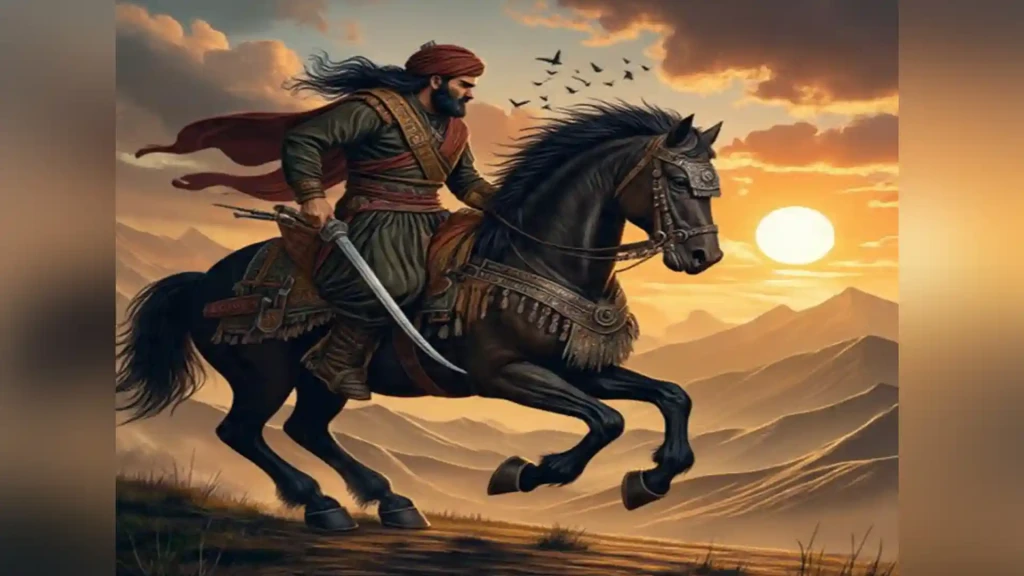
The Crusader leader Raynald of Châtillon was a major criminal. From the fortress of Kerak, he would attack caravans of Muslim merchants and pilgrims. Once, he showed the audacity to threaten attacks on Mecca and Medina. Moreover, he would brutally kill Muslim prisoners and insult the Prophet (PBUH). Upon hearing this news, Salahuddin burst into rage. Immediately, he took an oath that he would punish Raynald with his own hands and liberate Jerusalem.
The Battle of Hattin: A Turning Point in History
July 4, 1187. The Field of Hattin. On that day, Salahuddin’s army and the massive Crusader force faced each other. Initially, Salahuddin adopted an extraordinary strategy. He trapped the Crusaders in a location where there was no source of water. The day was intensely hot.
The Muslim army had already captured all water sources. On the other hand, Salahuddin’s soldiers set fire to the dry grass. As a result, the Crusaders became disoriented by the smoke of the fire and the thirst for water. Finally, in the face of the fierce attack by the Muslim army, the Crusader force collapsed like a house of cards. History knows this battle as the ‘Battle of Hattin’. In this war, King Guy of Jerusalem and the notorious Raynald of Châtillon were captured. Salahuddin executed Raynald according to his oath. However, he spared King Guy’s life out of respect for his rank.
Conquest of Jerusalem and Unique Magnanimity
After the victory at Hattin, the doors to Jerusalem effectively opened. On September 20, 1187, Salahuddin besieged Jerusalem. Inside the city, a French knight named Balian was leading the defense. After about 12 days of siege, the Christians realized that defeat was certain. Finally, on October 2, 1187, on a Friday in the holy month of Rajab, Salahuddin entered Jerusalem as a victor.
After a long 88 years, the melodious sound of the Adhan (call to prayer) was heard again in Bayt al-Maqdis. The pulpit of the Al-Aqsa Mosque was reinstalled. But Salahuddin’s victory was bloodless. When the Christians captured this city in 1099, they had flooded it with Muslim blood. In stark contrast, Salahuddin did not take revenge. Instead, he declared a general amnesty. He ordered that Christian churches remain intact.
According to the treaty, those who could pay ransom could leave safely. However, thousands of poor Christians were unable to pay the ransom. Then, Salahuddin and his brother Al-Adil freed thousands of prisoners using their own personal wealth. Even, he released the elderly, women, and children without any ransom at all. Seeing his mercy and magnanimity, many Christians embraced Islam. Western historians have also lavished praise on this conduct of Salahuddin.
The Third Crusade and King Richard
When the news of the fall of Jerusalem reached Europe, a great outcry ensued. Immediately, the Pope declared a new Crusade. As a result, King Richard the Lionheart of England, King Philip of France, and King Frederick Barbarossa of Germany set out for Palestine with massive armies. This was the famous Third Crusade of history.
Specifically, the battles between Richard and Salahuddin have become legendary in history. After the fall of the city of Acre, the Muslims retreated somewhat. But Salahuddin harassed Richard with his guerrilla tactics. He did not allow Richard to advance towards Jerusalem.

Chivalry of Salahuddin and Richard
Even during the war, there was a strange mutual respect between Salahuddin and Richard. Although they considered each other enemies, they respected each other as warriors. For example, during the Battle of Arsuf, Richard’s horse was killed. Then, Salahuddin saw that the opposing king was fighting on foot. He said, “It does not befit a king to fight on foot.” Immediately, he sent two spirited Arabian horses as gifts for Richard.
Again, once when Richard fell ill, Salahuddin sent his own personal physician for him. Not only that, he sent ice and fresh fruit to alleviate the fever. Such a precedent of enmity is rare in world history. Through this event, Salahuddin proved that he was not just a warrior, but also a man of a noble heart.
The Treaty of Ramla and End of the War
After fighting for a long time, both sides became exhausted. Richard realized that it was impossible to capture Jerusalem while Salahuddin was alive. On the other hand, a rebellion by his brother had appeared in Richard’s own country. Finally, in 1192, the ‘Treaty of Ramla’ was signed between the two leaders.
According to the terms of this treaty, Jerusalem remained in Muslim possession. However, Christian pilgrims were granted permission to travel safely and practice their religion. Some coastal cities remained under Crusader control. Richard returned to Europe praising Salahuddin. Salahuddin proved that he knew not only how to wage war but also how to establish peace.
Salahuddin as Ruler and Reformer
Salahuddin was not only successful on the battlefield; he was also outstanding as a ruler. After coming to power, he built a massive citadel in Cairo, Egypt, which still attracts tourists today. Moreover, he built numerous Madrasas (schools) and hospitals to spread education. He believed that only proper education could take a nation forward.

He placed special importance on educational institutions to propagate Sunni ideology. During his reign, agriculture and commerce expanded massively. He reduced taxes so that common people would not suffer. Specifically, he arranged for free medicine and treatment in hospitals. In his time, Egypt’s economy and culture reached a new height.
Salahuddin in the Justice System
In terms of justice, Salahuddin was uncompromising. Once, a Jewish merchant complained against him to the Qadi (Judge). The allegation was that Salahuddin had unjustly occupied his land. The Qadi summoned Salahuddin to court.
Surprisingly, despite being the Sultan, he appeared before the judge like a common man. He went to court without any protocol or security. Although the trial showed that the land belonged to Salahuddin and the deed was correct, nevertheless, he did not disappoint that Jewish merchant. He gave him the land as a gift and praised his courage. He used to say, “Justice is the foundation of the kingdom. Where there is no justice, there is no peace.”
Personal Life and Simplicity
In his personal life, Salahuddin was extremely austere and simple. Even at the peak of power, he never wore royal robes. He wore ordinary cotton or woolen clothes. Luxury could never touch him. He preferred staying in a tent on the battlefield rather than in a royal palace.
He regularly recited the Quran and performed Tahajjud prayers. Even on the battlefield, his tent was like that of ordinary soldiers. He looked after his soldiers like his own children. Occasionally, he would go out in disguise to see the condition of the city. His smile was always humble and amiable. He never spoke harshly to anyone.
Death and Last Breath
The year was 1193. After Richard left, Salahuddin returned to Damascus. But long fatigue and illness consumed him. He was attacked by bilious fever. Gradually, his health began to deteriorate.
Finally, on March 4, 1193, after the Fajr prayer, this great Sultan passed away. He was only 55 or 56 years old. After his death, an incredible and heartbreaking truth was revealed. Upon opening his personal chest, it was found to contain only one gold coin and 47 silver coins. Which was not even enough to cover his funeral expenses. This was because he had donated all his wealth during his lifetime. Finally, his burial was completed with money borrowed from neighbors. He was buried next to the Umayyad Mosque in Damascus.
Legacy and Influence of Salahuddin
Although Salahuddin has died, his influence exists even today. He established the Ayyubid dynasty, which ruled the Middle East for nearly a century. But his greatest legacy is his ideology. He proved that power does not corrupt a man if there is fear of Allah in his heart.
In Western literature and history, Salahuddin has been depicted as a symbol of ‘Chivalry’. Dante Alighieri placed Salahuddin in a respectful position in his ‘Divine Comedy’. Sir Walter Scott highlighted Salahuddin’s magnanimity in his novel ‘The Talisman’.
Sultan Salahuddin Ayyubi (RA) was a ruler who considered love to be more powerful than the sword. He conquered Jerusalem, but an even greater victory was conquering people’s hearts. In today’s conflict-ridden world, his life and work are extremely relevant. He taught us how to remain a humble human being even at the peak of power.
He taught that showing mercy to the enemy is not a weakness, but the highest peak of heroism. Every stone of Jerusalem, every alley of Damascus still bears witness to his memory. As long as the world exists, Sultan Salahuddin Ayyubi (RA) will live on as a symbol of justice, heroism, and humanity.
Author: Arefin Al Imran (Music Director, Journalist & Writer).
References:
- Al-Bidaya wa’l-Nihaya – Hafiz Ibn Kathir (RA). (One of the most reliable sources of Islamic history, where Salahuddin’s reign and character are described in detail).
- The Life of Saladin – Baha ad-Din ibn Shaddad. (He was Salahuddin’s personal secretary and judge. Written as an eyewitness to Salahuddin’s life, this book is the most authentic document).
- A History of the Crusades – Steven Runciman. (Western perspective on the history of the Crusades and Salahuddin’s role).
- Saladin: Hero of Islam – Geoffrey Hindley. (Modern English biography highlighting his strategy and politics).
- Sultan Salahuddin Ayyubi – Qazi Abul Hussain. (One of the best and most popular biographies on Salahuddin written in the Bengali language).
- Al-Kamil fi al-Tarikh (The Complete History) – Ibn al-Athir. (Written by another famous contemporary historian of Salahuddin, containing detailed descriptions of the wars).
- Dastan Iman Faroshon Ki – Inayatullah Altamash. (A depiction of Salahuddin’s time and espionage stories in the style of a historical novel).
- Saladin: All-Powerful Sultan and the Unifier of Islam – Stanley Lane-Poole. (A classic biography written in the late nineteenth century).