

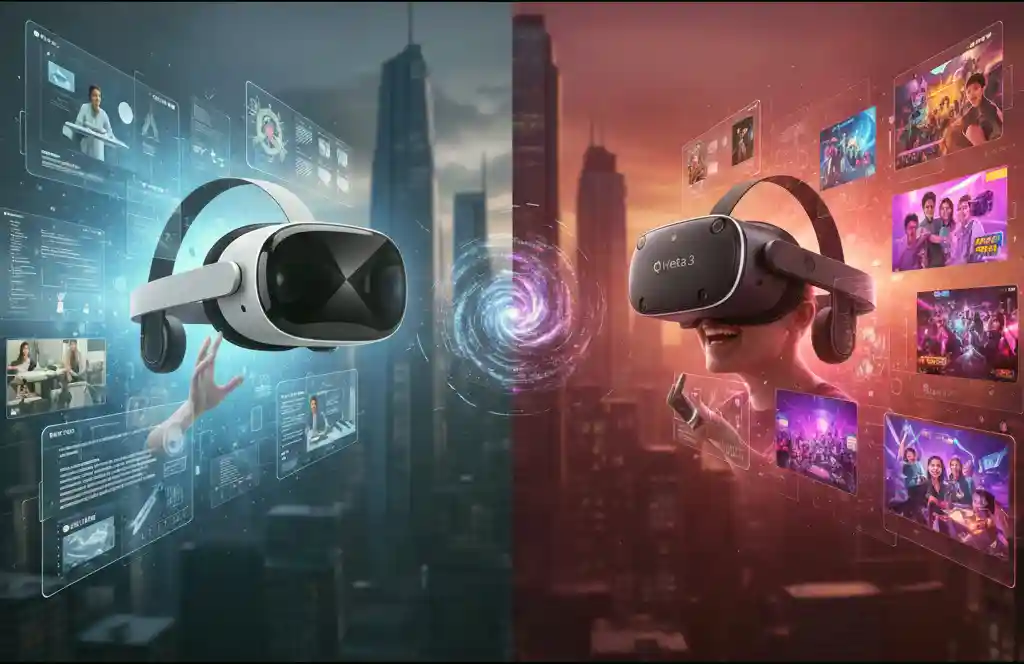

Is the smartphone era finally coming to an end? Current trends in the tech world certainly suggest so. A massive revolution in personal computing has set the stage for a head-to-head collision between two of the world’s leading tech giants: Apple and Meta.
On one side stands Tim Cook’s Apple Vision Pro, representing the pinnacle of high-end hardware; on the other is Mark Zuckerberg’s Meta Quest, a project built on affordability and the dream of a social metaverse. This battle for Mixed Reality (MR) is no longer confined to the laboratory—it has officially reached the hands of consumers.
Spatial Computing vs. The Gaming Empire
Apple is marketing the Vision Pro as a “Spatial Computer.” Their claim is that it isn’t just a headset, but a full-fledged alternative to your MacBook or iPad. For professionals looking to take productivity, cinema, or virtual meetings to the next level, Apple offers an unparalleled experience. In this digital world, there are no handheld controllers; the interface is controlled entirely by eye movements and simple finger taps.
Conversely, Meta’s objective is entirely different. Zuckerberg wants to bring the virtual world to the masses. The Meta Quest is primarily popular among gamers and the younger generation. With a massive library of games, social hangouts, and fitness apps, Meta currently commands the lion’s share of the Mixed Reality market.
The Tech War: A World Inside the Lens
Technologically speaking, the Apple Vision Pro is currently years ahead. It features 4K micro-OLED displays for each eye, nearly blurring the line between reality and the virtual space. In contrast, while Meta has significantly improved the lenses in its latest Quest models, the company prioritizes reducing device weight and maximizing user comfort.
The Price Barrier and Market Strategy
Market analysts believe the “Price Gap” is the most decisive factor in this war. The Apple Vision Pro’s astronomical price tag (roughly $3,500) positions it as a premium luxury product. In contrast, the Meta Quest is available for around $500, placing it well within the reach of the average middle-class consumer. While Apple fights for quality and ecosystem dominance, Meta is fighting for sheer user volume.
Signs of the Future
Standing here in 2026, it is clear that both companies are now pivoting toward Augmented Reality (AR) glasses. The goal is singular: to shrink bulky headsets down into devices that look like standard eyeglasses. We are moving toward a world where looking at a street brings up a digital map, or talking to someone displays a real-time translation right before your eyes.
Experts believe that while Apple may win on technical merit, Meta could win the numbers game. Ultimately, the consumer is the true winner; this competition is driving us toward a future where the boundary between the digital and physical worlds disappears entirely.