


The question of where the ancient Indo-Aryan people originally came from has fascinated scholars for over two centuries, and opinions remain divided even today. Early 19th-century German scholar Max Müller proposed that the Aryans originated somewhere in Central Asia and then split into two streams – one moving westward into Europe through Asia Minor, and the other entering the Indian subcontinent through the north-western mountain passes. Though this theory dominated academic circles for decades, it was later largely abandoned.
Most modern historians and archaeologists now agree that the original homeland of the Indo-European (or Indo-Aryan) peoples lay in the vast steppe grasslands stretching from present-day Poland in the west to southern Russia and Central Asia in the east, roughly between 3000–2000 BCE. Environmental pressures, population growth, internal conflicts, and the search for new pastures eventually forced different branches of these pastoral nomadic tribes to migrate in multiple directions.
One branch moved westward and became the ancestors of the Greeks, Romans, Celts, Germans, and Slavs. Another branch travelled south-east through the Iranian plateau and gave rise to the ancient Persians (the word “Iran” itself comes from “Aryan”). A third branch crossed the Hindu Kush mountains through the north-western passes and entered the Indian subcontinent around 1500–1400 BCE. Archaeological and linguistic evidence, including inscriptions discovered in Cappadocia and northern Syria mentioning “Mitanni” rulers with Indo-Aryan names and deities as early as 1400 BCE, strongly supports this timeline.
Religious Beliefs of the Early Vedic People :
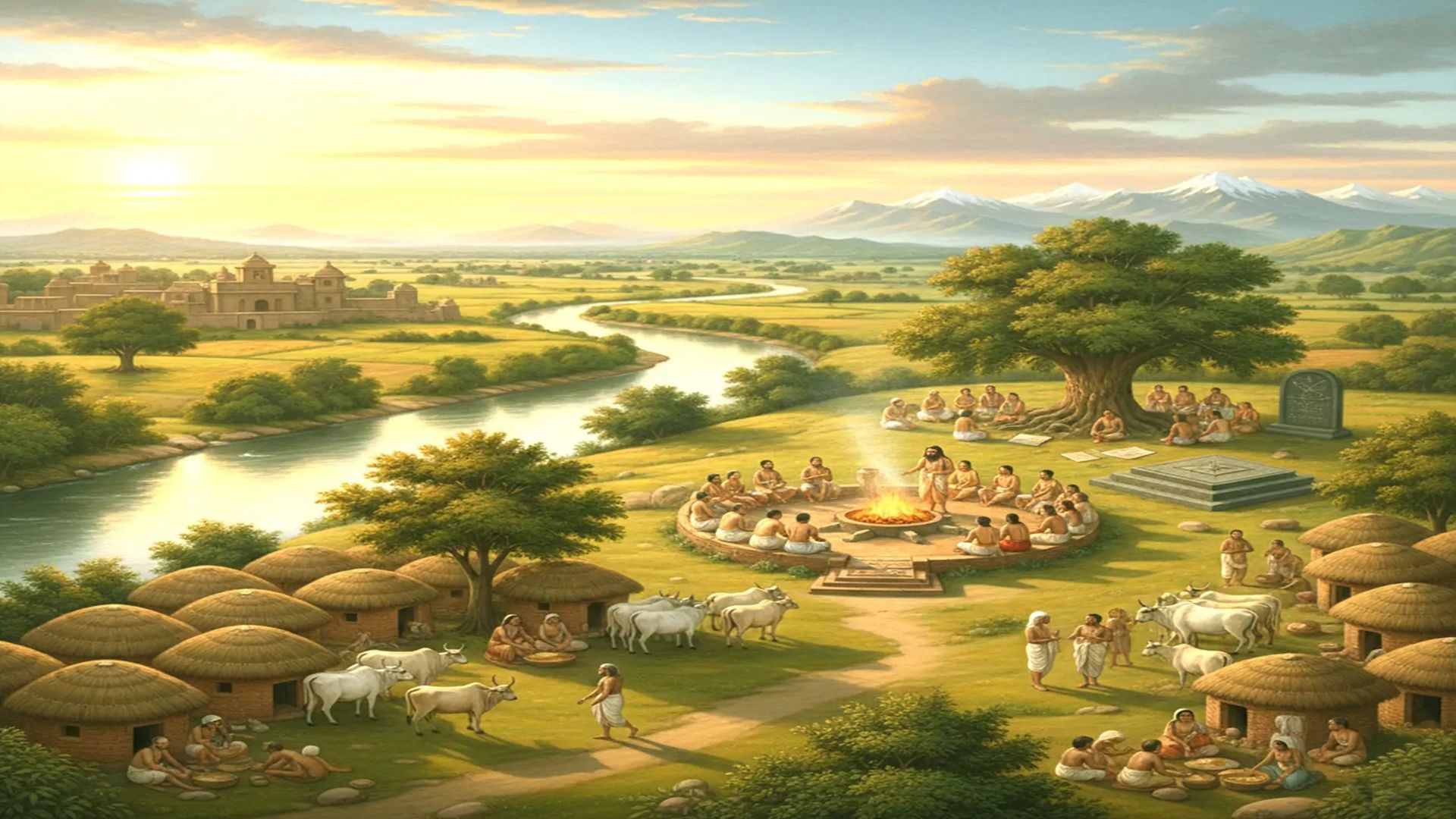
The religion of the early Vedic Aryans was remarkably simple, poetic, and nature-centred. They stood in awe of the grand forces of the natural world and personified them as gods and goddesses. The sky was Dyaus Pita (Father Sky), the earth was Prithvi (Mother Earth), the storm and thunder god was the mighty Indra, the god of rain and cosmic order was Varuna, the wind gods were the Maruts, fire was Agni, and the dawn was the beautiful goddess Usha. The sun (Surya), rivers (especially Saraswati), and many other natural phenomena were also worshipped.
Yet, even in this polytheistic framework, a clear undercurrent of monotheism or monism is visible. Numerous Rigvedic hymns speak of “the One Reality known by many names” or “the One who is the inner soul of all gods”. This idea reaches its philosophical peak in the later Upanishads with the famous declaration “Ekam evadvitiyam” – “The Truth is One, though the wise call it by many names”.
Ritual life centred around the sacred fire. Offerings of milk, ghee, barley, and soma (a sacred plant extract) were poured into the consecrated fire while priests chanted hymns from the Vedas. In the earliest phase, there was no idol worship or temple culture. Worship was directed toward the powers of nature through fire and poetic praise.
Over centuries, as the Aryans settled in the Gangetic plains and came into prolonged contact with the indigenous Dravidian, Mundari, and other cultures of the subcontinent, their religious practices absorbed new elements – temple worship, iconography, new deities, and elaborate sacrificial rituals gradually appeared. By the 6th century BCE, the excessive complexity and exclusiveness of Vedic ritualism provoked a powerful reaction that gave birth to Buddhism and Jainism – two revolutionary movements that rejected animal sacrifice, caste rigidity, and priestly domination.
The Vedas: The World’s Oldest Extant Religious Literature :
The word “Veda” comes from the Sanskrit root vid – “to know”. The Vedas are therefore “Knowledge” par excellence – the sacred wisdom revealed to ancient seers (rishis) in moments of deep meditation.
There are four Vedas:
- Rig Veda – the oldest and most important, a collection of 1,028 hymns in praise of various deities, composed in highly sophisticated poetry.
- Sama Veda – largely drawn from the Rig Veda but arranged for melodic chanting; it is the foundation of Indian classical music.
- Yajur Veda – contains prose and verse formulas used in sacrificial rituals.
- Atharva Veda – the latest of the four, dealing with everyday concerns: healing herbs, magical incantations, domestic rituals, and philosophical speculations.
Each Veda is divided into four layers:
- Samhitas (the core hymns)
- Brahmanas (ritual explanations)
- Aranyakas (forest treatises for recluses)
- Upanishads (philosophical dialogues – the crown of Vedic thought)
The Vedas were not composed by any single author at one point in time. They evolved orally over many centuries (roughly 1500–500 BCE) and were transmitted from teacher to disciple with extraordinary accuracy long before they were finally written down.
Importantly, the geographical references in the Rig Veda – rivers such as the Saraswati, Sindhu (Indus), Vipasa (Beas), Sutudri (Sutlej), the Himalayas, and the seven rivers of Sapta Sindhu – are all located within the Indian subcontinent. There is no mention of any river, mountain, or region outside this area. This strongly indicates that the Rig Veda was composed after the Indo-Aryans had already settled in north-western India and were gradually moving eastward into the Ganga-Yamuna Doab.
Thus, the Vedic civilization did not arrive in India fully formed. It grew, flowered, and transformed on Indian soil, absorbing and synthesising elements from the older indigenous cultures it encountered, eventually giving birth to what we today call Hinduism – one of the world’s oldest living spiritual traditions.