

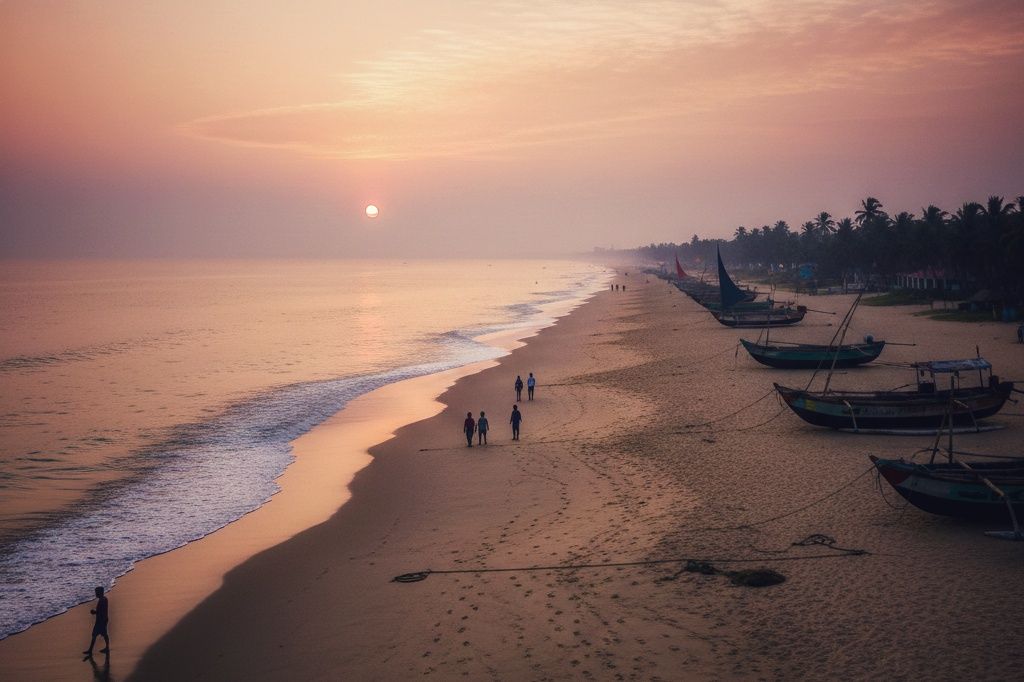

Cox’s Bazar means the roar of the turbulent sea and the blue waters of the horizon. Sunset here means a play of colors in the sky. When the twilight light falls on the waves of the sea, the entire beach is filled with gold. Thousands of people gather every day to see this scene. This longest continuous sandy beach in the world is not just a tourist center, but it is also an immense wonder of nature. All in all, Cox’s Bazar, located in the southeastern corner of Bangladesh, has everything to make it an ideal holiday destination.
Standing on this beach, which is about 120 (70 miles) long, it seems that the sea has no end. The shade of the jhauban and the touch of soft sand under your feet instantly make your mind feel good. Laboni, Sugandha or Kalatali-each point has its own atmosphere. Somewhere again, dark green hills stand tall next to the paved road of Marine Drive running along the sandy beach. Apart from the beauty of the sea, the touch of local Rakhine culture here adds a different dimension to tourism.
Also, the coral rocks and clear blue water of Inani Beach give a lot of the atmosphere of St. Martins. Sitting on the rocks at low tide and watching the sea creates a truly magical feeling.
Since this long coastline of the Bay of Bengal has been rarely explored, many people think that this beach has enough potential to compete with the likes of Pattaya in Thailand or Galle in Sri Lanka. But although popular with domestic tourists, due to local environmental factors and lack of proper conservation, tourists from the outside world are not able to reach the center of attraction in the same way. As a result, the arrival of foreign tourists is almost non-existent.
This should be the key to the new plan of the Bangladesh government surrounding this tropical paradise. If 10 percent of the current domestic tourist arrivals are foreign tourists, the Bangladesh government could earn $10 billion or more from tourism in the future, as an ideal holiday destination.
Hundreds of buildings have been built and are still being built there, occupying the beach area, which is having a negative impact on the environment. Many hotels, government buildings and shops built in recent years do not have proper planning permission. The jhaubana, known as the natural defense wall of the beach, is being cut down in the name of building tourism infrastructure. As a result, the beach is experiencing severe erosion by the sea tide. Looking at the main beach of Cox’s Bazar, it is clear that if the authorities do not take urgent action, the ambitious dream of becoming an international tourist attraction will remain a dream and will never reach reality.
Until about two decades ago, Cox’s Bazar was a sleepy beach town. This beach town was the center of attraction for people at a certain time of the year to breathe a sigh of relief from the noise and pollution of big cities like Dhaka or Chittagong. A time that attracted most Bangladeshis. But over time, the environment for laying eggs of sea turtles is being destroyed due to the construction of structures scattered around the beach and excessive lighting at night. The habitat of red crabs and rare species of marine life is also under threat today.
However, considering the scenario of two decades, the entire landscape has been changed by the unplanned development structure and hundreds of hotel buildings, apartment blocks and restaurants have been built in the area. In addition, hundreds of shops selling souvenirs, toys, clothes and fast food have been built along the main beach. Most of the hotels and motels do not have their own STP (Sewage Treatment Plant). As a result, the waste from the hotels and the city is directly mixed with the sea through the drains, which is poisoning the sea water. Due to the pressure of additional tourists, a huge amount of plastic waste is accumulating on the beach every day. At the beginning of this year (2026), a one-hour clean-up operation collected about 250 kg of plastic waste.
Environmentalists fear that if the illegally constructed buildings along the main beach are not removed soon, the area will never be restored and Cox’s Bazar will lose its original beauty forever.
Sources say that in the past years, the High Court has ordered the demolition of illegal structures from the Cox’s Bazar sea beach at various times, but in many cases it is not fully implemented due to influential circles. Sources say the main problem is that many government buildings have also been built in the sea beach area, due to which this program is not seeing success. However, recently (January 2026), the High Court has issued strict orders to protect the “natural character” of the beach.
In addition, without adequate roads, drainage and open spaces, Cox’s Bazar city has become a ‘concrete jungle’. This traffic jam takes a terrible form during the tourist season.
According to the information available in the analysis of various comments in this regard, it is seen that several high-ranking government officials, starting from the former Tourism Minister of Bangladesh, have admitted that some unplanned development has increased in Cox’s Bazar in the past years and that no effective measures have been taken to protect this area. Although there is a ban on the construction of any kind of building or permanent infrastructure on the southern side of the sea beach on the Marine Drive road from Cox’s Bazar to Teknaf, it is seen that hundreds of new buildings and infrastructure have been constructed there. Which is not only limited to the seashore but also threatens the hills near the Marine Drive road.
Indiscriminate felling of trees on the hillsides for infrastructure development and land clearing for construction of buildings. As a result, we frequently see landslides during the monsoon season. During heavy rains in June, people die when banks of mud collapse and houses are buried.
According to information received from many local residents and several employees, many tourists take corals home as souvenirs. As a result, traders and locals often collect corals and sea shells from nearby islands like St. Martin.
The current Deputy Commissioner of Cox’s Bazar, Mohammad Abdul Mannan said, that the government has taken several steps to preserve Cox’s Bazar. The planned Cox’s Bazar Development Authority will supervise and control all new building construction in the area. But it is not clear whether this will be enough to save Cox’s Bazar alone. Currently, the government and the ILO have jointly undertaken a new plan called the ‘Destination Development Plan for Cox’s Bazar (2025-2027)’. Which includes ensuring eco-tourism, modernizing the sewage system, and restoring the original appearance of the beach by freeing it from illegal encroachers. This will increase the number of foreign tourists in the future.
Cox’s Bazar is not just a tourist destination, it is a living ecosystem. To maintain this beauty, more emphasis needs to be placed on conservation than development.
(Information collected and written by Rakibul Islam Rafi-Epic Verse Journal)