

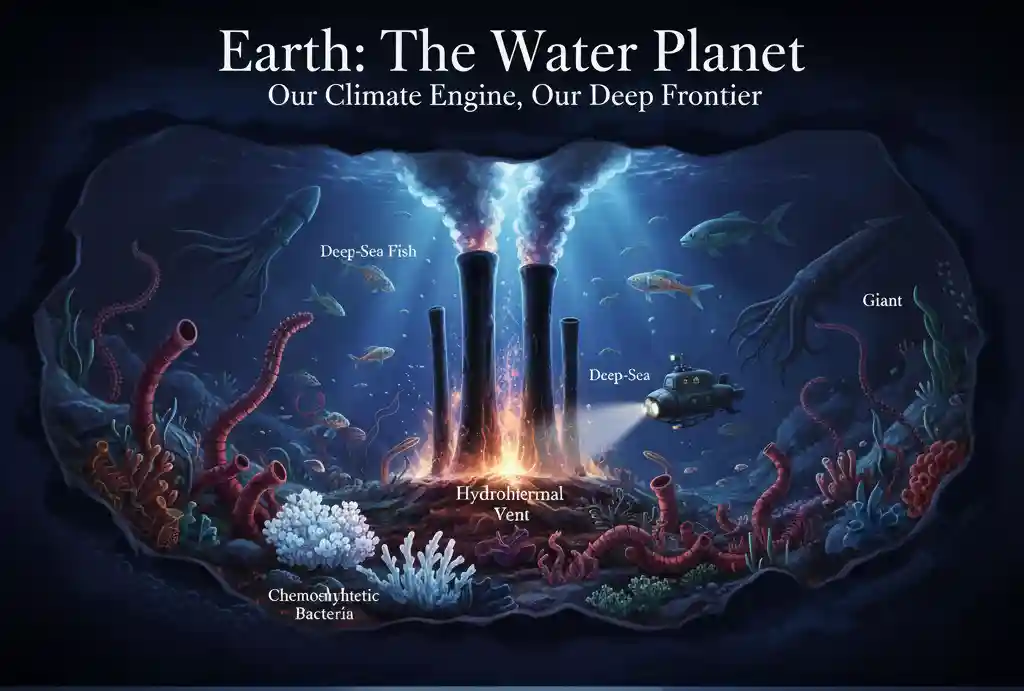

In the vast emptiness of space, our Earth is a bright blue dot. Compared to other planets in the solar system, Earth’s most significant feature is its abundant water. Although ancient valleys of ice have been found on Mars, and there is a possibility of liquid water beneath ice-covered layers on Jupiter’s moons, to date, Earth remains the only planet with vast reservoirs of liquid water on its surface. This abundant water resource has earned Earth the title of the ‘water planet’.
About 71 per cent of Earth’s total surface is covered by salt water. In contrast, freshwater in rivers or lakes accounts for less than 1 per cent. However, water is not limited to its liquid form; it also exists as a gas in the atmosphere and as solid ice in the polar regions and on mountain peaks. In the form of clouds, water constantly covers about half of the Earth’s surface. Even deep within the Earth, vast amounts of water and gas are trapped inside igneous rocks, which are continuously released during volcanic eruptions.
According to scientists, the Earth’s vast water supply was not created in a single day. The present oceans and atmosphere began to take shape about 3.9 billion years ago, as the Earth started to calm down from intense bombardment by meteors and comets. It is believed that the comets and meteors that crashed into the Earth for millions of years were the primary source of water and gas on the planet.
Currently, 97 per cent of the Earth’s total water is stored in the oceans. Most of the remaining 3 per cent is frozen as the vast ice sheets of Antarctica and Greenland. Rivers, lakes, and mountain glaciers contain a very small portion of the total water.
Water is the key to the origin and development of life on Earth. It is believed that the first stirrings of life occurred deep in the oceans. Every diverse form of life that has existed on Earth to date depends on water. Sixty to seventy per cent of a living cell is water. Even two-thirds of an adult human body is composed of water. A person cannot survive for more than a week without water. Not only that, but the process of photosynthesis by ancient plants ensured the supply of oxygen in the atmosphere, which later aided in the evolution of the animal kingdom.
The Earth’s water is not static; it regularly circulates through various cycles. The slowest of these cycles is the ‘plate tectonics. ‘Driven by the Earth’s internal heat, this process works over millions of years to form continents and alter ocean basins. Rocks melt during this process, releasing gases and water that return to the Earth’s surface in volcanic eruptions.
This volcanic activity also provides a significant amount of the salt in the water. Seawater undergoes chemical processes that turn it into saltwater when it comes into touch with the hot rock of mid-ocean ridges. Rainwater that runs into rivers and transports silt and salt to the ocean also erodes and mixes with terrestrial rocks.
The water on the Earth’s surface is circulated very rapidly by the sun’s heat energy in a process known as the “hydrologic cycle” or water cycle. Clouds are created when water evaporates from the ocean’s surface and returns to the ocean or land as rain.
In the ocean’s uppermost layer, winds generate currents that mainly move east to west near the equator. But water also moves through the ocean’s deep depths. The polar regions’ water cools and thickens, lowering to the ocean floor and gradually moving toward the equator. The full cycle of these deep ocean currents can take several hundred years. The Earth’s “heating system”, or heat regulation system, is this system.
When the warm surface currents travel toward the polar regions and the cold deep currents return toward the equator, this is known as the ‘Global Ocean Conveyor Belt’. These currents play a crucial role in regulating the Earth’s climate. For example, it is because of this current that Northern Europe has a much milder and more comfortable climate, despite being at the same latitude as Canada.
This vast water cycle of the Earth is not just the environment but the primary shield for the survival of human civilisation. Therefore, protecting every drop of water on this blue planet is essential for our survival.
References:
- ‘Gross, M. Grant & Elizabeth Gross’ – ‘Oceanography: A View of Earth’ (Seventh Edition).
- ‘Berner, E. A. & Berner, R. A.’ – ‘The Global Water Cycle’ (Prentice Hall).
- ‘NASA Earth Observatory’ – Information on the Earth’s water cycle and ocean currents.
- ‘USGS (United States Geological Survey)’ – General information on the hydrologic cycle and groundwater flow.
- ‘NOAA (National Oceanic and Atmospheric Administration)’