

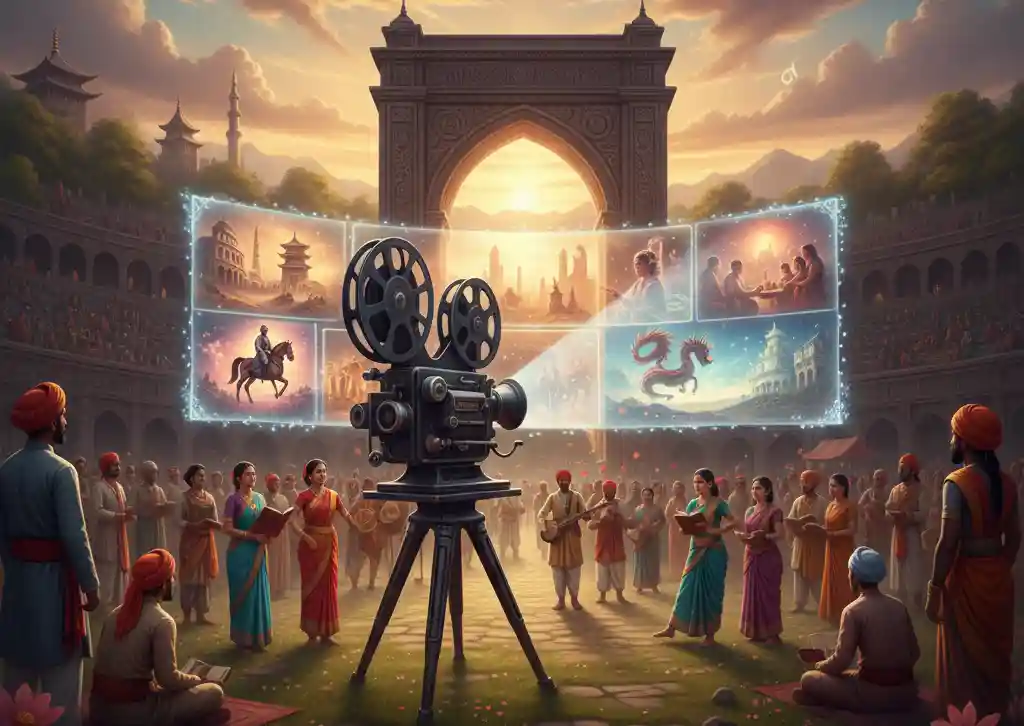

A very familiar debate in the history of cinema is—‘Was the book better than the movie?’ While the answer varies depending on the viewer or critic, this deep relationship between film and literature did not begin today. Rather, in 1895, when Louis Lumière made the first fiction film ‘L’arroseur arrosé’ was an adaptation of an 1889 comic strip. In other words, from the very birth of cinema, it has evolved by drawing upon other art forms. Even a century later, that question of ‘fidelity’ remains one of the most unresolved issues in the world of film.
The roots of this tradition lie in the early days of cinema, when there was no separate professional structure for screenwriting, and filmmakers turned to classical literature and stage plays. There were both artistic and commercial reasons for this. On one hand, making films based on the stories of Shakespeare or Dickens allowed filmmakers to avoid complex copyright issues. On the other hand, presenting familiar tales to the general public made it easier to attract audiences.
In the early 20th century, films like Edwin S. Porter’s ‘The Great Train Robbery’ (1903) or ‘A Dream of a Rarebit Fiend’ (1906) drew their material from contemporary theater and comic strips. This trend was not limited to America; In Britain and Europe, there was also a craze for adapting the works of timeless authors like Zola, Tolstoy, or Goethe.
Film theorists generally categorize how faithful a film will be to its source material into three main types: strict, loose, and free adaptation.
Often, filmmakers like Stanley Kubrick take the essence of the original novel to present their own new perspective. In 1971, ‘A Clockwork Orange’ Upon its release, original author Anthony Burgess rejected it. He complained that Kubrick had omitted the book’s underlying tone and instead highlighted the violence and negative aspects. However, Kubrick’s work as a film is now acclaimed worldwide. In contrast, Peter Jackson’s ‘The Lord of the Rings’ The trilogy is a rare example where he not only faithfully captured Tolkien’s vast world but also elevated it to a unique cinematic height.
In the early days, films were only three to five minutes long. As a result, the main parts or specific scenes of Dickens’s sprawling novels or Shakespeare’s intricate plays (such as: the famous school scene from Nicholas Nickleby) it was impossible to tell the entire story. As film lengths began to increase around 1910, a frantic attempt was made to condense entire novels into 20 minutes. Works like ‘Frankenstein’ (1910) or ‘Don Quixote’ (1915) were produced in this way.
The technical limitations of the time were immense. The camera was static, and the scenes were like distant, static photographs. But in the late 1910s, with the advent of camera movement, new angles, and creative editing, cinema emerged as a mature art form. D. W. Griffith’s ‘The Birth of a Nation’ (1915) opened a new frontier for the feature-length narrative film.
Research has shown that adapting ‘popular’ genres like detective, gangster, or science fiction is more advantageous for filmmakers than adapting classic literature. This is because readers are less rigid in these areas, giving filmmakers more freedom to use their creativity. Many filmmakers of the French New Wave gained worldwide acclaim by working with pulp fiction or detective stories.
When filmmakers like Stiller adapted Selma Lagerlöf’s novel into a film, it wasn’t merely a transformation but became a new poem. And Carl Theodor Dreyer’s “The Passion of Joan of Arc” (1928) stands unique in film history because every line of dialogue was taken from the actual transcript of Joan of Arc’s trial.
Is a worthwhile adaptation simply about staying faithful to the original book? Or should it be a creation that can be understood even without reading the source material? Today’s film critics believe that cinema cannot be just a mirror of literature; it must be original.
Despite the objections, films like ‘Clueless’ based on Jane Austen or ‘Joe Macbeth’ based on Shakespeare prove that the story’s appeal doesn’t fade even when the medium changes. The journey of adaptation from cinema’s infancy to the present is, in essence, the transmission of a heartbeat from one art form to another.
References:
★Ben, Marvin N., and Richard J. Superfine. 1994. “§ 117—The Fourth Generation Right of Adaptation and the Source Code Generator’s Dilemma.” John Marshall Computer & Information Law Journal 537.
★Miller, Arthur R., and Michael H. Davis. 2000. Intellectual Property: Patents, Trademarks, and Copyright in a Nutshell. 3rd ed. St. Paul, Minnesota: West Group.
★Plotkin, Mark E., editor. 2003. E-Commerce Law and Business. New York: Aspen.