

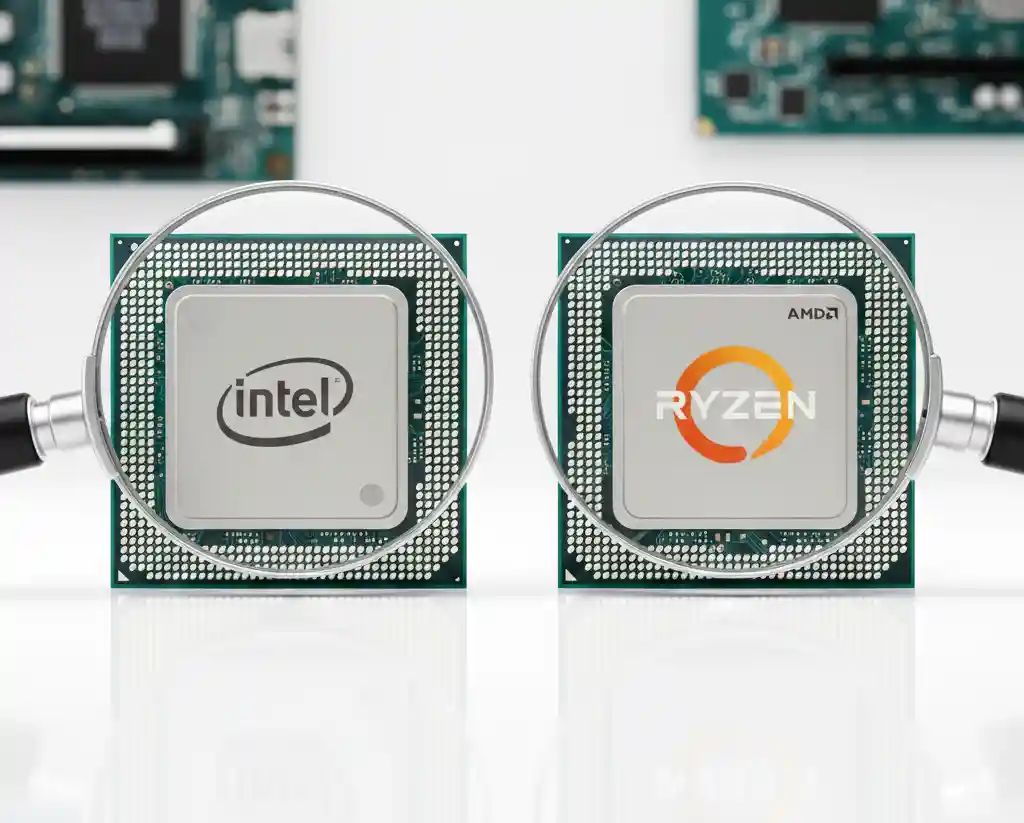

Intel was once the undisputed king of the tech market. But in recent years, AMD has completely changed that equation with its ‘Ryzen’ series. To understand which one is right for you in the current context of 2026, you need to look at a few key factors.
If you’re a user who primarily does internet browsing, Microsoft Office, Zoom meetings, and occasionally watches movies, then processors from both companies will serve you excellently. However, there are some subtle differences:
Intel (Intel Core Ultra): Intel’s latest ‘Core Ultra’ series’ hybrid architecture (P-cores and E-cores) helps open common apps quickly. In laptops, Intel’s optimization is still slightly ahead.
AMD (AMD Ryzen): AMD is quite efficient when it comes to multitasking or using multiple apps at once. For those who keep many tabs open in their browser or play music in the background, a Ryzen 5 or Ryzen 7 will deliver excellent performance.
Many casual users also enjoy doing some light gaming or video editing from time to time.
Integrated Graphics: If you don’t have the budget to buy a separate graphics card (GPU), AMD is the clear winner here. AMD’s Ryzen processors with built-in ‘Radeon’ graphics can easily run many popular games (like FIFA, Valorant).
Intel Arc: Although Intel has improved by adding ‘Arc’ graphics to its new processors, AMD is still the top choice for the general public when it comes to gaming stability.
For laptop users, battery life is the most important factor.
AMD: AMD processors are currently much more power-efficient. This means they consume less power for the same performance, resulting in a cooler laptop.
Intel: While Intel was previously criticized for overheating, their new chips (Panther Lake and beyond) have largely solved this issue. Still, AMD will have a slight edge in battery life.
For the average user, the biggest deciding factor is budget.
Budget Segment: In the 10,000 to 25,000 price range, AMD processors generally offer more cores and threads, which prevents the PC from slowing down in the long run.
Premium Segment: If you’re willing to spend a lot of money and prioritize brand value, you can opt for Intel’s Core i7 or Core Ultra 9. However, for the average user, AMD remains the most cost-effective solution.
Why Choose One Over the Other? (Summary)
Feature Intel AMD
Single-core speed Excellent (apps load fast) Good
Multitasking Good Excellent (benefit of more cores)
Gaming (without a graphics card) Average Best (Radeon Graphics) Power Consumption More Less (more economical) Price Relatively budget-friendly.
Long-Term Thinking (Future-Proofing) for 2026
One important thing to keep in mind is motherboard support. AMD with their ‘AM5’ socket support for a long time. This means that if you buy an AMD processor today, you can upgrade to a new processor in a few years without changing your motherboard. With Intel, you have to change your motherboard almost every two generations, which is costly for the average user.
Finally, if you’re a casual user on a budget, the AMD Ryzen 5 or Ryzen 7 series processors are the best choice for you. They offer good graphics, long battery life, and excellent multitasking performance all at once.
On the other hand, if you use professional software that partners with Intel (like certain Adobe applications or specialized office tools) and don’t want to compromise on stability, then an Intel Core i5 or Core Ultra 5 will be a reliable choice for you.