

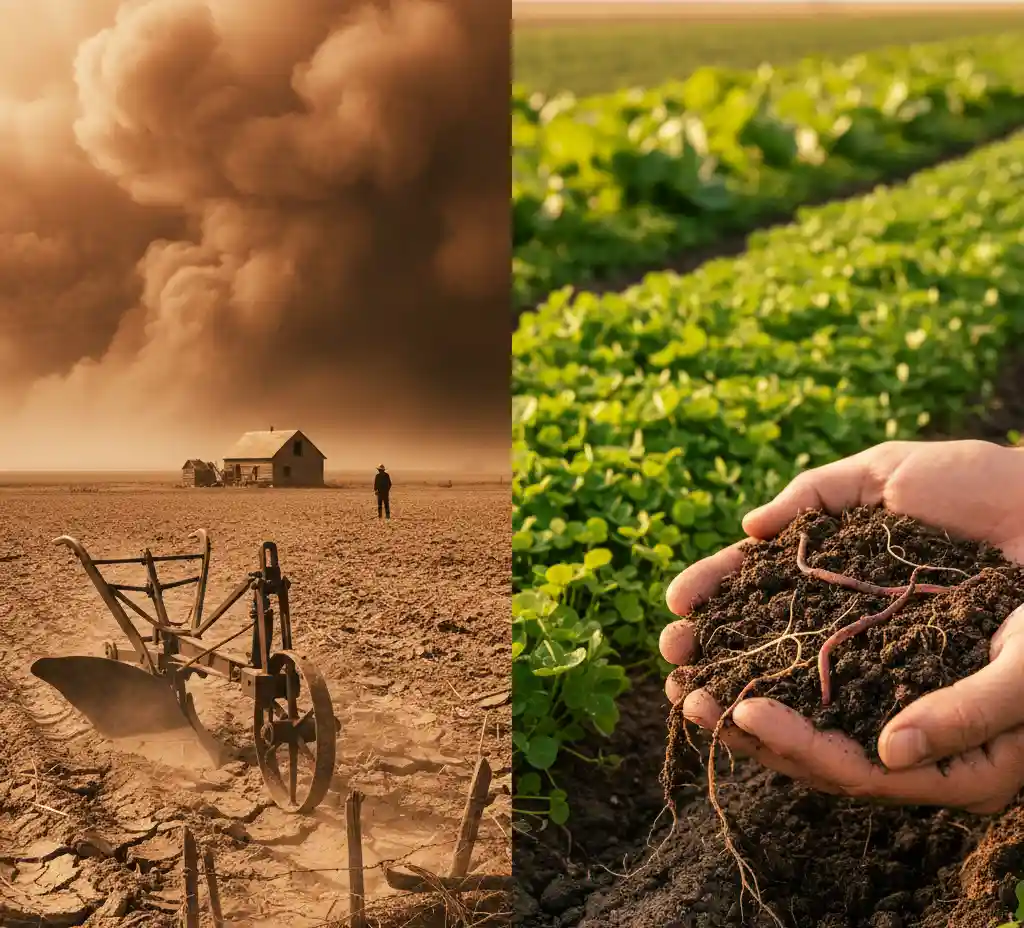

The very soil that formed the foundation of civilization is now facing a crisis. For millennia, humans have tilled and turned the soil in the hope of reaping golden harvests. But modern agricultural science suggests that excessive tillage or ’tillage’ (Tillage) has, in the long run, become a curse rather than a blessing for the soil. From ancient times to the present, this evolution of cultivation is not just a change in technique, but an epic tale of human civilization’s survival.
When agriculture began in the Near East ten to twelve thousand years ago, humans had only a digging stick. It was the loosening of the soil with that wooden implement that marked the beginning of modern agriculture. Over time, that stick evolved into the hoe and the triangular plow. When people in Mesopotamia first learned to have animals pull a plow around 3000 BC, it brought about a revolutionary change in agriculture.
Eighteenth-century British scientist Jethro Tull was the first to scientifically explain that loosening the soil allows roots to more easily absorb nutrients. This was followed by Charles Newbold’s cast-iron plow and, in 1837, John Deere’s steel plow, which took agriculture to a commercial level. In 1847, George Marsh said at a meeting in Vermont, “When man abandoned a nomadic life and began to cultivate the land regularly, a great revolution occurred in his social and family economy.” Essentially, the concepts of land ownership and permanent settlement were born through the use of this plow.
A historical note: at the beginning of the 20th century, powerful tractors replaced horses and mules. In the 1950s, the number of tractors surpassed animal power. But the Dust Bowl of the 1930s is proof that this mechanization was not always a blessing.
When the vast grasslands of the American Southwest came under the mechanical plow, their native grasses were destroyed. Exposed to drought and fierce winds, the soil turned to dust and began to fly into the air. The sky was darkened by that dust as far as the Atlantic coast. Millions of acres of land became unfit for farming, and thousands of people were forced to abandon their homes. Agricultural scientist Hugh Bennett warned at the time that soil erosion was, in fact, a long-term wound to civilization.
The use of chemical fertilizers in agriculture and the dominance of herbicides after the 1950s made farming easier. In the 1980s, ‘conservation tillage’ began to gain popularity. Its main goal was to cultivate the soil with no-till or minimal-till methods to retain moisture and prevent erosion.
However, this method was controversial at first. This is because without tilling the soil, large quantities of toxic herbicides or weed killers had to be used to control weeds, which posed a serious threat to the environment and human health.
Sustainable Agriculture: The Solution for the Future
Around 1989, a group of visionary farmers and scientists realized that it was not enough to just increase production; the soil also had to be saved. This gave birth to the ‘Sustainable Agriculture’ movement. The core principle of this method is:
Reducing Costs: Avoiding unnecessary mechanical tillage.
Natural Cycles: Controlling pests and increasing soil fertility naturally, instead of using chemicals.
Resource Conservation: Preventing soil erosion to keep groundwater and the environment free from pollution.
Today, farmers around the world are realizing that soil is not just dust, but a living resource. Modern tillage methods are no longer about blindly digging up the earth; rather, they are a conscious effort to grow crops while maintaining environmental balance.
According to agricultural experts, if we are not careful with soil protection today, a disaster like the Dust Bowl could return at any time. Only with healthy soil can human health and food security be ensured.