

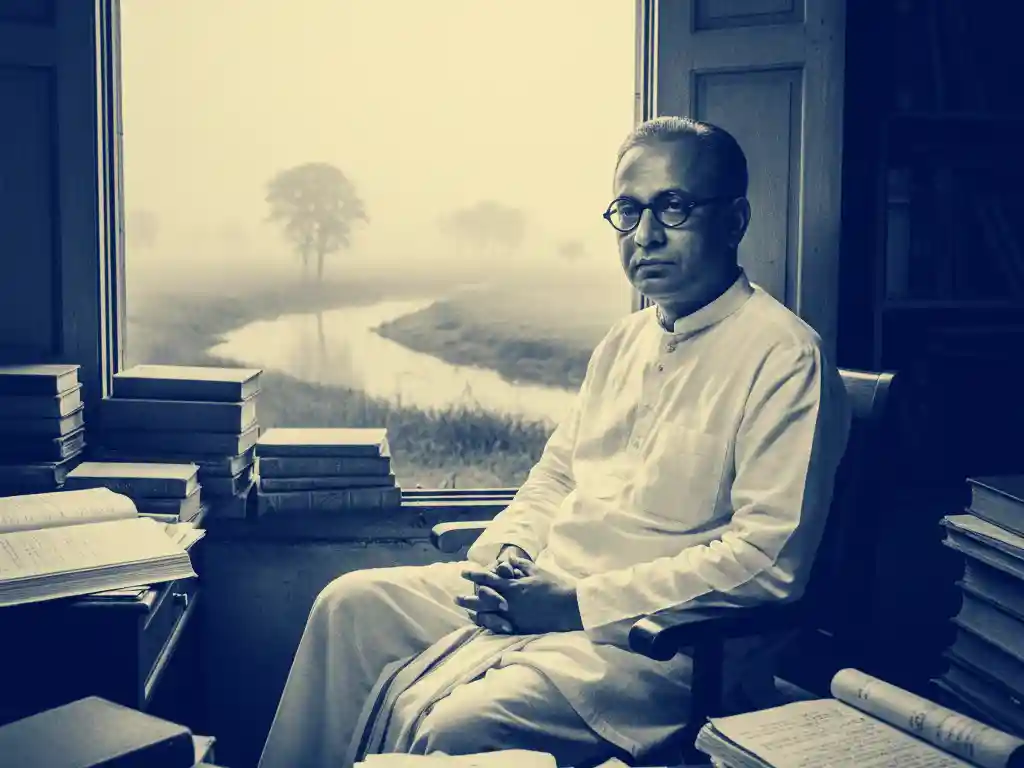

Of the few stars that shine in their own glory in the firmament of Bengali literature, the name of Jibanananda Das is pre-eminent. One of the foremost poets of the post-Rabindra era, he remained out of the public eye during his lifetime, a ‘recluse’, a reclusive man. Yet today, a century and a quarter after his birth, he remains ever-present in the very marrow and mind of the Bengali people. Through a unique blend of solitude, vivid imagery and surrealism, he has gifted Bengali poetry with a new modernity.
Jibananda Das was born on 17 February 1899 in the city of Barisal, in the then Bengal Presidency, to an educated Vaidya family. His ancestral home was in Bikrampur, Dhaka. His father, Satyanananda Das, was an ideal teacher and essayist, and his mother, Kusumakumari Das, was a renowned poet. His mother’s famous poem, ‘Adarsha Chele’, is still taught to children today. He was taught to read by his mother in his childhood and later passed with distinction from the Brij Mohan School and College in Barisal before moving to Calcutta for his higher education. He earned a bachelor’s degree in English from Presidency College and a master’s degree from the University of Calcutta.
Jibanananda’s poetry captures a grey, melancholic yet exquisite beauty of Bengal. He did not merely depict the landscape of rural Bengal but rather imbued its nature with a primal and magical quality. For this reason, Annadashankar Ray called him the ‘purest poet’, and Buddhadeva Bose dubbed him the ‘most solitary poet’.
His notable collections of poetry include:
★ Jhira Palak: First collection of poems (1927)
★ Dhuser Pandulipi: Where his own poetic language is expressed.
★ Bonlata Sen: One of the most popular love poems in Bengali literature.
★ Rupasi Bangla: Published after the poet’s death, this collection established him as the poet of the Bengali national sentiment and of nature.
Jibanananda’s professional life was far from smooth. Although he taught at various institutions, including City College and Braj Mohan College, he repeatedly had to endure the humiliation of unemployment. To support his family and alleviate poverty, he even worked as an insurance agent and a private tutor.
Surprisingly, although he was primarily known as a poet during his lifetime, 21 novels and 128 short stories were discovered after his death. Novels such as ‘Malyaban’ or ‘Sutirth’ prove that he was also far more modern in his prose than his contemporaries. His ‘Kobitar Kotha’ The essay collection is an invaluable document for the study of poetic theory in Bengali literature.
On 14 October 1954, he was seriously injured in a tram accident in Ballygunge, Kolkata. Surprisingly, in the last 100 years in Kolkata, there has been only one death in a tram accident—and that was Joydeepananda Das. Many researchers have suggested it was a ‘suicidal impulse’. However, no conclusive evidence has ever been found to support this. After an eight-day battle for his life, he passed away on 22 October 1954.
Even today, the relevance of Jayitananda Das has not diminished in the slightest. A ‘Jibanananda Das Research Centre’ has been established at Barisal University for the study of his literature. A literary prize has been established in his name in India and Bangladesh. His poetry is now being translated into English, French and other European languages. To the modern, thinking Bengali, Jibanananda is the ‘poet of the conquest of darkness’ who sings of light overcoming the darkness.
Source:
1. Banglapedia: National Encyclopedia of Bangladesh (Second Edition, 2012).
2. Sansad Bangali Charitavivaran: (Edited by Subodh Chandra Sengupta and Anjali Bose, 1st Volume).
3. Shuddotam Kobi: Written by Abdul Mannan Sayed (1972).
4. Jibanananda Das: Siraj Salekin, Jiboni Granthimala (2018).
5. A Poet Apart: Clinton B. Seely (biography and literary review of the poet).
6. The Letters and Literary Notes of Jibanananda Das (edited by Faizul Latif Chowdhury and Bhumendra Guha).