

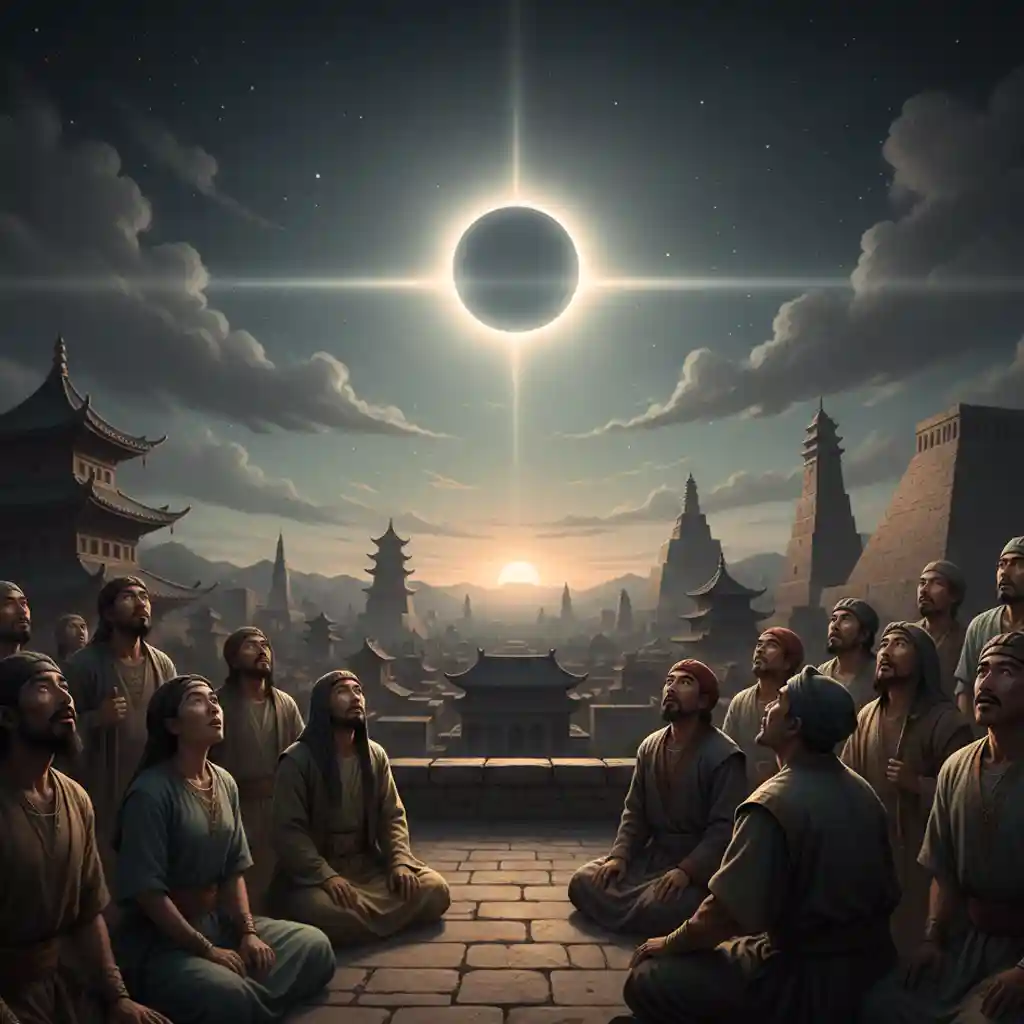

Humans always crave stability. Since the dawn of time, our ancestors looked at the sky and saw a realm of permanence. However, when a solar or lunar eclipse occurred, that peace shattered. Ancient people didn’t see a scientific alignment; they saw the hand of a god. They believed that when the sun went dark, a disaster was coming. This fear didn’t just stay in their hearts; it built religions, overthrew kings, and eventually birthed modern science.
Survival for early man was a daily struggle. To survive, humans used their large brains to identify patterns. We call this “cause and effect.” For example, they noticed that where there is water, there are animals to hunt. Eventually, they applied this logic to the sky. When they couldn’t explain thunder or wind, they turned to spirits. They believed powerful beings controlled every drop of rain and every gust of wind.
This desire to understand led to divination. People began searching for signs in nature to predict the future. The sky became the ultimate canvas for these messages. Because the heavens seemed so steady, any sudden change—like an eclipse—felt like a direct warning from the divine.
The people of Mesopotamia were the first to build a scientific foundation for astronomy. Their weather was harsh and unpredictable. Therefore, they needed to know when the rains would come to manage their irrigation. By 1375 B.C., they recorded their first eclipse.
Babylonian astronomers were incredibly diligent. During the reign of King Nabonassar, they started logging every celestial event. Eventually, they discovered the “Saros” cycle—an 18-year pattern where eclipses repeat. Here, science and religion were inseparable. Priests acted as both theologians and scientists. They performed rituals to please the gods while simultaneously calculating the movements of the stars to keep their society running.
In Ancient China, astronomy was a matter of state security. By the Shang Dynasty, astronomers were government officials. They believed astronomical events reflected the Emperor’s standing with the gods.
The Zhou Dynasty took this further with the “Mandate of Heaven.” The Emperor was the “Son of Heaven,” and he ruled only as long as he stayed in the gods’ favor. If an eclipse happened and the government failed to predict it, it meant the Emperor was losing his divine right to rule. The stakes were high—if the head of the astronomical bureau missed a prediction, the penalty was often execution by decapitation. An accurate prediction confirmed the Emperor’s power, while a missed one signaled potential revolution.
The Classical Greeks changed everything. They were the first to separate science from religion. Instead of blaming the gods, they looked for universal laws. Greek philosophers believed that humans could understand the world through pure reason.
They developed “cosmology” to study the origin of the universe. By observing eclipses objectively, they made a groundbreaking discovery: the Earth is a sphere. They realized an eclipse occurs because of the physical interaction between the Sun, Moon, and Earth. While they wrongly placed the Earth at the center of the universe, their move toward scientific observation paved the way for all future discoveries in the Islamic and Western worlds.
The journey of understanding eclipses is the journey of human progress. We moved from fearing the dark to calculating its arrival with precision. What was once a terrifying omen is now a beautiful event that brings people together to watch the sky. It reminds us that while we no longer fear the “Mandate of Heaven,” our quest for knowledge remains as vast as the universe itself.
| Feature | Mesopotamia | China (চীন) | Greece |
| View of Eclipses | Divine Omen | Political Mandate | Natural Law |
| Key Achievement | Saros Cycle (18 years) | Bureaucratic Tracking | Spherical Earth theory |
| Consequence | Rituals by Priests | Execution for failure | Scientific Models |