

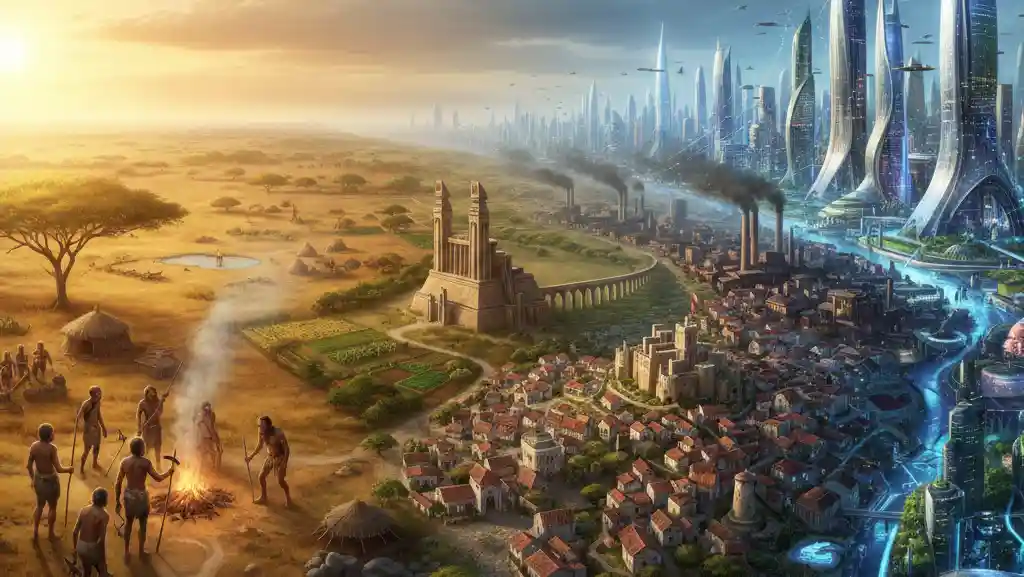

Human presence on Earth dates back approximately 3 million years. When a primitive species called Homo habilis began using stone tools in the savannas of East Africa, they had no idea that their descendants would one day become the undisputed dominants of the planet. From a small group of just 100,000 people to today’s vast sea of 8 billion—every turn in this journey tells a story of human intellect and the struggle for survival.
Anthropological and demographic studies show that the population growth rate of early humans was extremely slow. From around 3 million years ago, when the human brain was less than 500 grams, it grew to over 1 kilogram in subsequent evolution. This intellectual development helped humans to survive the competition. During the time of Homo erectus, the global population was only between 500,000 and 700,000.
The picture began to change with the emergence of Homo sapiens, or modern humans. Around 70,000 years ago, at the start of the last Ice Age, humans began to spread to Australia, Siberia, and the Americas. At this time, the world’s population was only about 1.5 million, the vast majority of whom were in Asia and Africa.
The First Step Towards Population Explosion
The biggest turning point in the history of population growth came around 10,000 to 8,000 BC, when people abandoned a nomadic lifestyle and adopted agriculture and animal husbandry. This is known as the ‘Neolithic Revolution’.
The influence of agriculture led to the Middle Eastern population growing from 200,000 to 5 million. In Europe, the population was 2 million in 4000 BC, which rose to 2.3 million by 2000 BC. The Indian subcontinent has historically been densely populated. While it had 3 million people in 3000 BC, by 2000 BC this had risen to between 20 and 25 million. The expansion of agricultural civilisation in the Huang He river basin of China led to a population of 20 million by 2000 BC.
A look at history shows that population growth has not always been linear or smooth. Climate change, famine, and especially infectious diseases have repeatedly pulled back the population wheel. In the 14th century, the plague, or the Black Death, devastated Europe’s population. Similarly, in Africa, the continent’s population stagnated for a long time due to the slave trade. Africa’s natural demographics were severely damaged by the enslavement of approximately 10 million people to the Americas and 4 million to Muslim countries.
The Industrial Revolution, which began in the eighteenth century, brought about the third and largest wave in demographic history. It was during this period that people realised that if the mortality rate could be controlled, the population would grow rapidly. Whereas the average life expectancy was just 35 years in 1800, by 2000 it had risen to 75 years.
In particular, the discovery of modern antibiotics and vaccines in the mid-twentieth century dramatically reduced the infant mortality rate. As a result, a vast ‘youth bulge’ was created in underdeveloped and developing countries.
One of the main determinants of population growth is the fertility rate. Interestingly, in France, voluntary birth control began as early as the 1700s, which reduced the average number of children per woman from 6 to 3 over the next 100 years. Japan experienced a similar trend. However, in most other countries, this change occurred much later. Today, fertility rates are also falling rapidly in Latin America, Asia, and Muslim countries.
The world population is projected to grow from 6 billion to 9 billion by the middle of the 21st century. However, the rate of this growth is now much slower due to the decline in fertility rates. The youth in developing countries are now much more aware and educated, which will help to create a stable population structure in the future.
This long journey of humankind proves that we are not merely a part of nature, but possess the ability to use it for our own needs. However, the greatest challenge today is to tackle the damage we are causing to the planet in providing for the food, clothing and shelter of this vast population.
References:
★Biraben, Jean-Noël (1979). “Essai sur l’évolution du nombre des hommes.”
★McEvedy, Colin & Jones, Richard (1978). Atlas of World Population History.
★United Nations (2001). World Population Prospects: The 2000 Revision.
★Durand, John D. (1977). “Historical Estimates of the World Population: An Evaluation.”
★Das Gupta, Ajit (1972). “Study of the Historical Demography of India.”