


Here is the translation of your article into English, written in a fluid, engaging, and tech-forward style that captures the evolution from “Smart” to “Intelligent.”
For the past decade, the device in our pockets has been known as a “smartphone.” But Artificial Intelligence (AI) is fundamentally redefining that term. Today’s phones don’t just follow your commands; they understand your needs and offer solutions before you even ask.
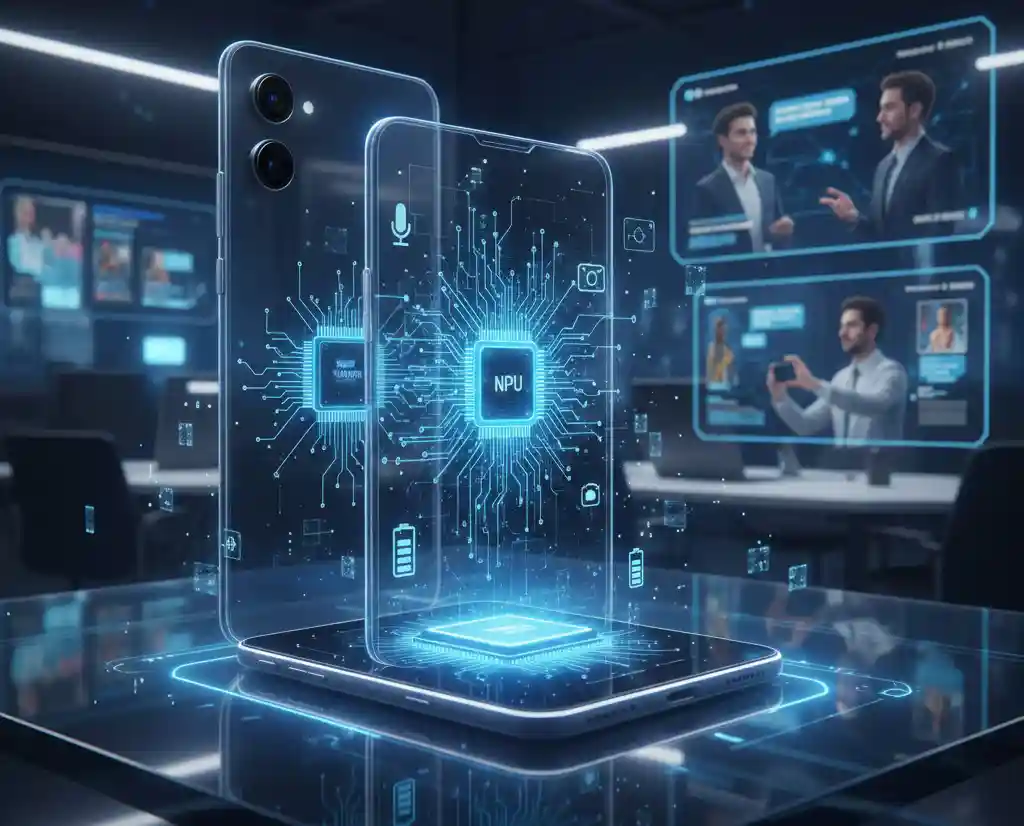
In simple terms, an AI Phone is a device whose hardware and software are specifically engineered to process artificial intelligence tasks. While traditional smartphones rely heavily on the cloud or the internet, an AI phone utilizes its own NPU (Neural Processing Unit) to make complex decisions locally—a concept known as On-device AI.
This isn’t just about a chatbot or a voice assistant. It is an integrated system that autonomously optimizes the camera, battery management, typing experience, and even phone calls.
In the near future, the smartphone will cease to be a mere communication tool; it will become our personal digital companion or “digital twin.” Here are the shifts we are beginning to see:
Future phones will prioritize “context” over typing. You might jot down a messy, disorganized note, and your phone will instantly transform it into a professional email. Removing unwanted objects from a photo or changing a background will happen in the blink of an eye. We are already seeing the first glimpses of this in the Google Pixel and Samsung Galaxy S-series.
AI phones are set to revolutionize real-time translation. You could be speaking in Bengali while the person on the other end hears you in Japanese. This won’t require third-party apps; the AI will function at the system level, fundamentally changing the landscape of global business and tourism.
One of the greatest perks of an AI phone is its efficiency. The device learns your habits—knowing which apps you use at specific times. It will automatically manage background processes and distribute processor power, potentially increasing battery life by 30–40%.
Future camera sensors won’t just capture light; they will use AI to reconstruct every pixel. Whether shooting in extreme low light or using high-magnification zoom, AI will use its intelligence to restore lost details. Even a casual user will be able to capture professional-grade photography.
It is a misconception that simply downloading an app makes a phone an “AI phone.” True intelligence requires powerful hardware. Chipsets like Qualcomm’s Snapdragon 8 Gen 3 or Apple’s A-series are designed to perform billions of operations per second. A phone truly becomes an AI phone when it can run Large Language Models (LLMs) locally, without needing an internet connection.
Data security is a major concern as phones begin to analyze our personal habits. However, experts suggest that On-device AI is actually a solution. Since your data is processed locally within the hardware rather than being sent to a cloud server, the risk of hacking and data leaks is significantly reduced.
Looking ahead, we may see phones without physical buttons—or perhaps the screen itself will become secondary as smartphones act as central hubs for “AI Pins” or “Smart Glasses.” Your phone will play music based on your mood, alert your doctor if it detects a health dip, and manage your meeting schedule autonomously.
The smartphone is no longer just a tool; it is becoming a digital extension of the human brain. By 2030, we may be using devices that fulfill our needs before we even have the chance to think of them.
The AI phone is not just a passing trend; it is an inevitable evolution. For those who once took time to transition from keypad phones to touchscreens, this shift will be even more breathtaking. Soon, the device in your hand may know you better than you know yourself.
The future is knocking at our door—and its name is the Artificial Intelligence Integrated Smartphone.