

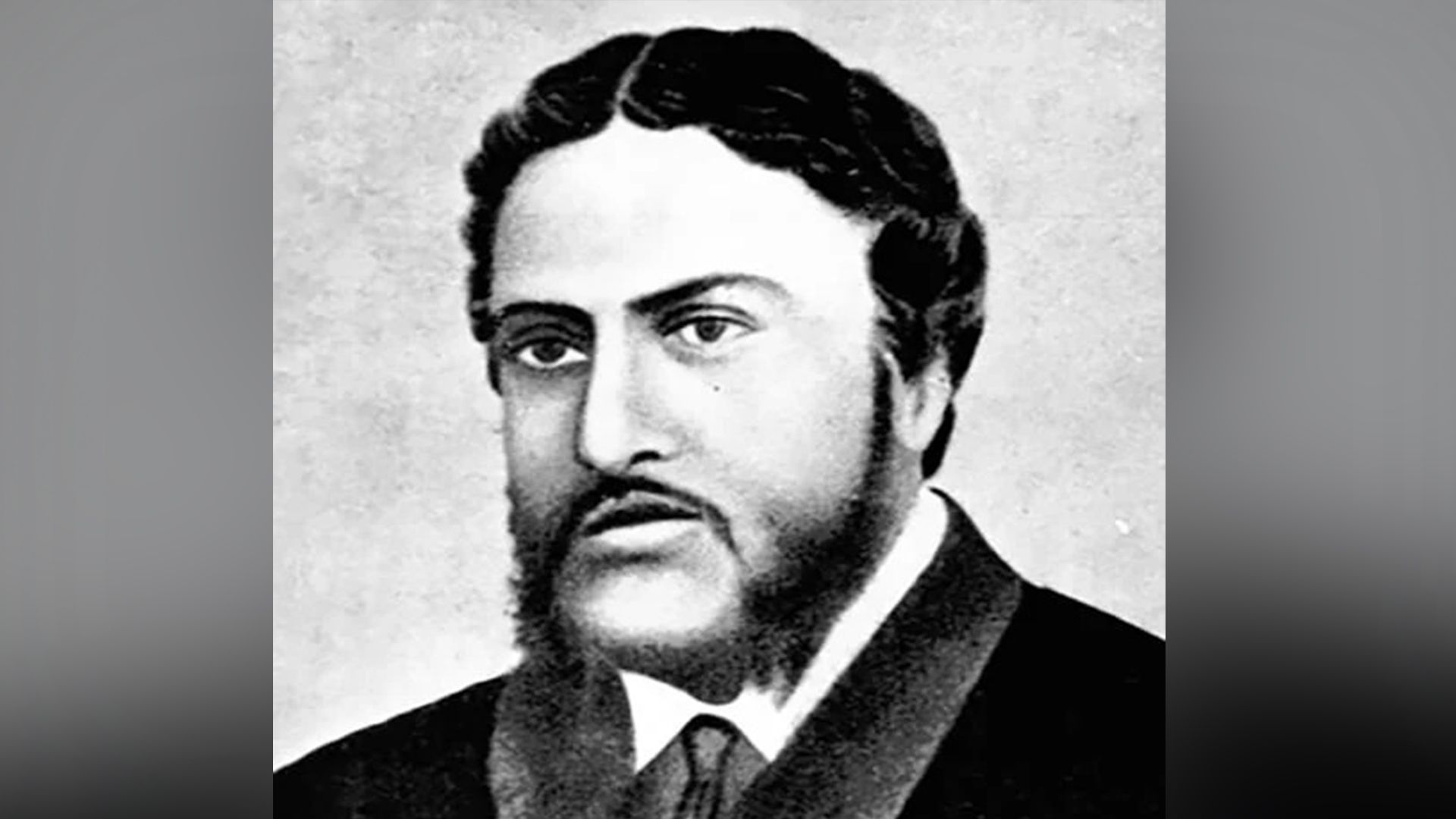

If one single individual can be called the architect of modernity in a thousand years of Bengali literary history, that person is Michael Madhusudan Dutt. Today marks the 202nd birth anniversary of this blazing star of Bengali letters — the poet who shattered the iron chains of medieval payār metre and gave Bengali poetry the taste of freedom. We remember not just a poet but a revolutionary spirit who single-handedly altered the course of Bengali literature forever. In the horizon of the 19th-century Bengal Renaissance, he shone as the brightest constellation, and in his light Bengali language discovered its universal voice.
Early Life and the Allure of the West: A Dreamer’s Journey
Born on 25 January 1824 on the banks of the Kopotaksha river in Sagardari, Jessore, into a wealthy zamindar family, young Madhusudan could not be contained by the gentle rural life. Restlessness coursed through his veins; in his eyes burned the distant dream of England. He firmly believed that only by writing in English could one achieve world-wide fame. That conviction led him to convert to Christianity and take the name “Michael”. Yet fate played a cruel joke: the very Western society whose recognition he craved never truly embraced him. His English poem The Captive Ladie (1849) displayed undeniable genius but failed to bring the glory he sought. The lack of appreciation wounded him deeply.
Return to the Mother Tongue: Discovering the True Treasure
The greatest tragedy — and simultaneously the greatest gift — of Madhusudan’s life was his disillusionment. Living abroad, he realised that expressing oneself in a foreign language was like adorning oneself with borrowed jewels. His soul cried out:
“Hail Bengal! In thy treasury lie jewels of every kind —
Yet I, foolish one, scorned them all,
Maddened by greed for alien wealth, I wandered far…”
That very regret became Bengali literature’s greatest blessing. He returned to the lap of his mother tongue and picked up a pen sharper than any sword. The new Michael began to transform the very direction of Bengali literature.
Amitrākṣar Chhanda: The Liberation of Poetry
Before Madhusudan, Bengali poetry was meant primarily to be sung and was shackled within the rigid 14-syllable payār metre. He understood that this form was inadequate for expressing the complex emotions of modern man. He introduced blank verse — amitrākṣar chhanda — into Bengali poetry and freed it from the compulsion of end-rhyme. For the first time, Bengali verse resounded with grave, lofty, heroic tones. Through his hands, Bengali poetry acquired dramatic intensity and epic grandeur.
Meghnadbadh Kavya (1861): The Epic That Broke Tradition
The publication of Meghnadbadh Kavya remains a landmark event in Bengali literature. Where Valmiki’s Ramayana presented a simple equation of sin and virtue, Madhusudan gave it profound human complexity. He displaced the conventional hero Rama and placed the supposed villain Ravana and his son Meghnad at the very centre of the epic.
Madhusudan’s Ravana is no demonic sinner; he is a patriotic king, a loving father, and a tragic hero who refuses to bow even when fate strips him of everything. Blending the style of Homer, Virgil, Dante and Milton with Indian mythology, Madhusudan created Bengali literature’s first successful epic in which mortals — not gods — occupy the foreground.
Plays and Sonnets: Opening New Horizons
Madhusudan’s genius was not confined to epic poetry. He brought modernity to Bengali drama as well. Through plays such as Sharmishtha, Padmavati and Krishnakumari he introduced Western dramatic conventions to the Bengali stage; Krishnakumari remains Bengali literature’s first successful tragedy.
He was equally masterful in farce. In Ekei Ki Bole Sabhyata and Buro Shaliker Ghare Ron, he lashed contemporary society’s hypocrisy and moral decay with biting satire.
In poetry, he revolutionised yet another form by introducing the sonnet. Following Petrarch, his Chaturdashpadi Kabitabali proved how flexible and powerful the Bengali language could be. His famous sonnet “Kopotaksha Nad” still echoes in Bengali hearts as a nostalgic lament.
Personal Life: A Life as Tragic as Greek Drama
Madhusudan’s own life was as epic and tragic as his creations. Extravagance, reckless living and relentless misfortune repeatedly plunged him into poverty. His final days were spent in extreme hardship and illness. He died penniless in Alipore General Hospital. The man who had enriched Bengali language with unparalleled splendour departed this world with a heart full of unfulfilled sighs. Yet, thanks to the generosity of great souls like Ishwar Chandra Vidyasagar, his priceless works were preserved for posterity.
Legacy: An Eternal Constellation
Michael Madhusudan Dutt was not merely a poet; he was the maker of an era. He taught us how to remain rooted in tradition while embracing modernity. He gave Bengali literature the audacity to stand shoulder-to-shoulder with world literature.
Even in this mechanical age, Madhusudan’s relevance has not faded. Whenever we wish to feel the power and majesty of the Bengali language, we must return to the thunderous verses of Meghnadbadh. On this birth anniversary, we offer our humble homage to this great poet. As long as Bengali language and literature endure, Michael Madhusudan Dutt will continue to flow in Bengali hearts like the eternal murmur of the Kopotaksha river.